




How to Enrich Your B2B TAM with Technographic and Intent Data
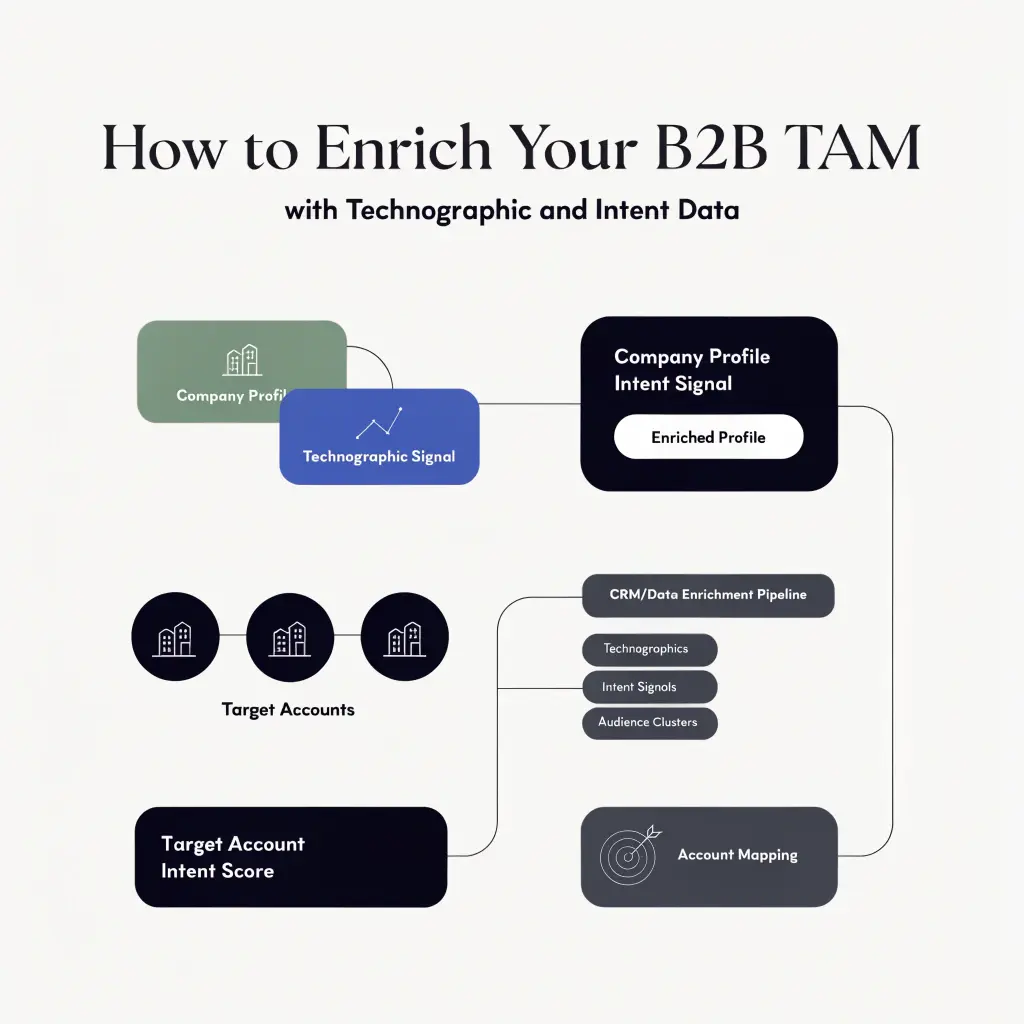
If you ask most B2B sales leaders how big their Total Addressable Market (TAM) is, they will point to a massive spreadsheet. They pull data on industries, company sizes, and revenue brackets, and conclude, "There are 50,000 companies in our TAM."
Research from LinkedIn B2B Institute shows that at any given time, 95% of your TAM is "out-market" (not ready to buy). Only 5% is "in-market" (actively looking for a solution).
If your sales and marketing teams are targeting all 50,000 companies with the same aggressive sales pitch, you are burning cash, exhausting your sales reps, and annoying 95% of your prospects.
To build a highly efficient revenue engine, you must stop treating your TAM as a static list. You need to enrich it with Technographic and Intent data. Here is exactly how to combine these data streams to find your 5%.
What are the Core Elements Required to Define Data Layers?
Before building a targeted strategy, we need to define the components of the B2B customer database. This will help enrich a modern TAM. Relying on just one market intelligence layer is why companies fail to find active buyers.
The 3 Data Layers of Market Intelligence
| Data Layer | What It Tells You? | How It Relates to the 95:5 Rule? |
|---|---|---|
| Firmographics | Company size, revenue, industry, and location. | Defines the 100% of your market. It builds the initial, massive list. |
| Technographics | The exact software and hardware tools a company currently uses. | Filters the 100%. It removes companies that lack the infrastructure to use your product. |
| Intent Data | The active research and digital behavior of a company. | Identifies the 5%. It highlights which qualified companies are actively in-market. |
Why Technographic Data is the Infrastructure?
Technographics tell you the exact hardware and software footprint a company currently operates on. It reveals what CRM they use, how mature their data security is, when they likely signed their current vendor contracts, and the renewal time.
If firmographics tells you the address of a house, technographic data gives you the blueprint of the plumbing. You cannot sell a complex software integration to a company if you do not know what systems they are already running behind closed doors.
How Technographics Enriches Your TAM?
Technographics allow you to segment your market based on technical compatibility rather than just company size.
- Integration Plays: Segment companies that use software your product natively integrates with.
- Displacement Plays: Segment companies using your direct competitors so you can run targeted "rip-and-replace" campaigns.
How Intent Data Tracks High-Intent Accounts?
Intent data tracks a company's digital behavior to signal when they are actively researching a specific topic or solution. This data is gathered through first-party sources (like visiting your website) and third-party sources (like reading articles on publisher networks or searching software review sites).
How does it enrich the Total Addressable Market (TAM)?
Intent data solves the timing problem. It filters your TAM down from "companies that fit our profile" to "companies that fit our profile and are trying to solve a problem right now."
How to Find Your Active 5% Using the Multiplier Effect?
Industry benchmarks reveal a massive gap between traditional and data-driven teams. Companies that leverage combined data enrichment see up to a 35% increase in pipeline conversion rates because they know the 95:5 rule.
Technographics alone show a static picture. Intent data alone won't give you actionable insights (a college student doing research can trigger a false intent spike). But when you combine them, you create a highly accurate, dynamic TAM.
Let's understand this with an example:
Assume you sell a specialized analytics tool that integrates perfectly with Snowflake but competes heavily with Legacy Tool X.
- Firmographics alone: You target a mid-market software company. (Result: Cold outreach to the 95% out-market. Low conversion).
- Firmographics + Technographics: You find a mid-market software company running Legacy Tool X and Snowflake. (Result: Better targeting, but they still might not be ready to buy).
- Firmographics + Technographics + Intent: You find a mid-market software company running Legacy Tool X, and their intent signals show they are actively researching "Legacy Tool X data migration strategies."
That is your 5%. By combining the data, your sales rep isn't making a cold call; they are making a highly contextual, timely intervention.
How Can You Put Data Enrichment into Action in 3 Simple Steps?
Having the data is useless if it just sits in a dashboard. Here is how expert revenue teams utilise this intelligence directly in their daily operations.
Step 1: Map the "Friendly" and "Hostile" Tech Stacks
Sit down with your product and sales teams to define exactly which software environments make your product shine, and which ones cause friction.
- The Friendly Stack: Technologies that make your product more valuable (e.g., if you sell an email marketing tool, Salesforce might be a friendly stack).
- The Hostile Stack: Technologies that make your product redundant or incredibly difficult to implement.
Use a technographic data provider to instantly filter your entire TAM, disqualifying the hostile stacks and prioritizing the friendly ones.
Step 2: Establish Your Core Intent Topics
Do not just track when people search for your brand name. Work with your marketing team to identify the exact keywords and topics that indicate a buyer is experiencing a specific pain point.
- Track competitor names (e.g., "Competitor pricing," "Competitor alternatives").
- Track outcome-based topics (e.g., "How to reduce cloud compute costs," "Automating SOC2 compliance").
Step 3: Build a Dynamic Routing Matrix in Your CRM
This is where the strategy becomes automated. You must configure your CRM (like Salesforce or HubSpot) to score and assign accounts based on real-time data changes.
The biggest mistake teams make today is treating their TAM as a static list that gets updated once a year.
A modern TAM is a living heartbeat. If your CRM isn't configured to alert a rep the exact moment an account spikes in relevant research, you are leaving millions on the table.
Create this automated workflow:
- Baseline: All accounts in the TAM are scored based on Firmographic + Technographic fit.
- Trigger: When a highly qualified account surges in third-party Intent data, their score spikes.
- Action: The CRM automatically assigns the account to a sales rep with a specific messaging playbook tailored to the exact tech stack they use and the topic they were researching.
Conclusion
Enriching your B2B TAM with technographic and intent data is no longer a futuristic concept; it is a mandatory strategy. Building this foundation of competitive marketing intelligence allows you to see exactly who fits your profile, what infrastructure they run on, and when they are experiencing active pain.
As a result, you stop selling and start consulting. You lower your Customer Acquisition Cost (CAC), protect your brand reputation, and ensure that every hour your sales team spends prospecting is an hour spent on the active 5% that can actually close.
Frequently Asked Questions (FAQs)
1. What is TAM enrichment in B2B marketing?
TAM enrichment is the process of enhancing your Total Addressable Market data with deeper insights such as technographics, buying intent, firmographics, and behavioral signals to improve account targeting and sales prioritisation.
2. Why is technographic data important for B2B sales and marketing?
Technographic data helps businesses identify the technologies, software, and platforms companies already use. This allows GTM teams to target accounts with stronger compatibility and higher conversion potential.
3. How does intent data improve account prioritisation?
Intent data reveals which companies are actively researching relevant products or services online. This helps sales and marketing teams focus on accounts showing real buying interest instead of relying only on static account lists.
4. How can enriched TAM data improve GTM performance?
An enriched TAM helps businesses reduce wasted outreach, improve lead qualification, increase pipeline efficiency, and prioritise high-intent accounts that are more likely to convert into revenue opportunities.
5. How can Demand Curve Marketing help improve B2B TAM targeting?
DCM helps businesses enrich their TAM with intent data, account intelligence, and accurate audience targeting to identify high-fit accounts, prioritise active buyers, and improve pipeline efficiency through data-driven GTM strategies.
6. How does DCM maintain accurate and reliable TAM data for B2B targeting?
DCM combines intelligent automation with human validation to deliver verified & accurate B2B data. Supported by an 8-step vetted quality process, DCM maintains a 97% deliverability rate, helping businesses enrich their TAM with reliable technographic and intent insights while reducing wasted outreach and dead-end prospecting.