



TAM, SAM & SOM: An Easy-to-Understand Guide for Better Market Sizing
Accurate market sizing is the foundation of a credible growth strategy. Whether you are launching a startup, introducing a product, or entering a new market, TAM, SAM, and SOM help you move beyond assumptions and quantify the opportunity.
These three metrics show the total market potential, the portion your business can serve, and the share you can realistically capture. In this guide, we explain what TAM is, what TAM means in business, what TAM, SAM, and SOM stand for, how to calculate TAM, SAM, and SOM, and how to use them for better business decisions.
What Is TAM, SAM & SOM?
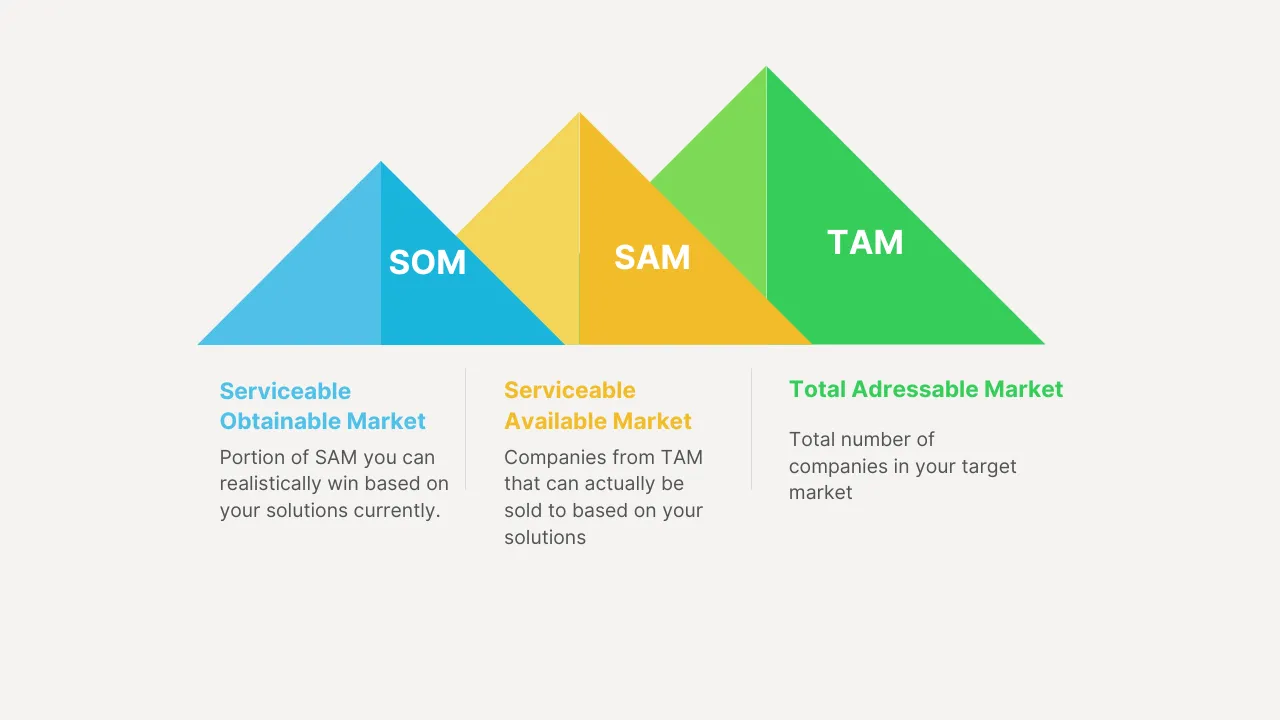
TAM, SAM & SOM are a strategic framework used to estimate market size and identify realistic business opportunities.
Instead of assuming that all potential customers are buyers, this framework divides your market into three quantifiable groups, enabling businesses to develop attainable growth strategies.
Here's a simple way to understand them:
| Metric | Meaning | Example |
|---|---|---|
| TAM | Total Addressable Market | Every business worldwide that could use your software |
| SAM | Serviceable Addressable Market | Businesses your product currently supports |
| SOM | Serviceable Obtainable Market | Customers you can realistically win within the next few years |
For B2B companies, defining the total addressable market is only the first step. Businesses can further enrich their TAM using technographic and intent data to identify high-fit accounts and prioritize companies showing active buying signals.
What Is TAM?
TAM stands for Total Addressable Market.
It represents the total revenue opportunity if every potential customer purchased your product or service. In simple terms, TAM answers one important question:
"How big could this market be if there were no limitations?"
TAM Meaning in Business
Suppose your company develops project management software.
Assuming there are 10 million businesses in the world that might need your software and you charge $300 per year as an annual subscription fee, your TAM would be:
10 million × $300 = $3 billion
This does not imply that your business will earn $3 billion. Rather, TAM assists companies in realizing the size of the opportunity as large as possible and then drilling it down into market segments that are more achievable. Investors also apply TAM to assess the size of a business in the market and whether it is large enough to promote growth in the long term.
What Is SAM?
SAM stands for Serviceable Addressable Market. SAM, or the Serviceable Addressable Market, is the portion of your TAM that your business can actually serve using its products, locations, resources, and capabilities.
Unlike TAM, SAM considers real-world limitations. These may include:
- Geographic reach
- Industry focus
- Product features
- Customer requirements
- Regulatory compliance
- Business model
SAM Market Example
Let's continue with the project management software example. Although your TAM has 10 million businesses around the world, you can only offer your software to those companies in the United States and Canada with between 20 and 500 employees.
That reduces your addressable market to around 800,000 businesses.
At $300 annually, your SAM becomes $240 million. As your company expands into new countries or industries, your SAM can also grow.
What Is SOM?
SOM stands for Serviceable Obtainable Market.
This is the percentage of your SAM that your business can realistically acquire based on its current position in the market. Even if your SAM is worth hundreds of millions of dollars, you're unlikely to capture all of it immediately.
Factors influencing SOM include:
- Sales capacity
- Marketing budget
- Competition
- Brand awareness
- Customer acquisition strategy
- Distribution channels
For example, if your SAM is worth $240 million and you feel that you can get 5% of that market over the next five years, your SOM equals $12 million.
Unlike TAM and SAM, SOM is concerned with realistic business objectives instead of market potentials that are hypothetical.
What Is the Difference Between TAM, SAM and SOM?
Although these three terms are closely related, they measure different stages of market opportunity.
Think about it this way.
Imagine opening a coffee shop.
TAM is everyone who drinks coffee.
SAM is coffee drinkers living within your delivery area.
SOM is the number of customers you can realistically attract despite competing cafés nearby.
This basic model assists companies not only in formulating realistic revenue forecasts but in developing feasible growth strategies.
TAM SAM SOM Example for Better Understanding
Let's look at another real-world example.
A company develops AI-powered HR software.
Total Addressable Market (TAM)
There are 500,000 businesses worldwide that could benefit from HR software.
Average annual subscription: $2,000
TAM = $1 billion
Serviceable Addressable Market (SAM)
The software currently serves only businesses in North America with over 100 employees.
Potential customers: 75,000 companies
SAM = $150 million
Serviceable Obtainable Market (SOM)
Considering competition, sales resources, and brand awareness, the company expects to acquire 3,000 customers.
SOM = $6 million
This example demonstrates how businesses gradually narrow a broad market into realistic revenue opportunities.
How to Calculate TAM, SAM and SOM?
Calculating competitive marketing intelligence and market size becomes much easier when you break it into simple steps.
Step 1: Calculate TAM
Multiply: Total potential customers × Average annual revenue per customer
For example: 250,000 customers × $800 = $200 million TAM
Step 2: Calculate SAM
Now filter that market using factors like:
- Geographic location
- Industry
- Customer type
- Product capabilities
- Legal or operational limitations
This creates your Serviceable Addressable Market.
Step 3: Calculate SOM
Estimate the percentage of SAM you can realistically capture by analysing:
- Current sales capacity
- Marketing investment
- Competition
- Customer demand
- Distribution network
- Brand recognition
Answering these questions makes it easier to understand how to calculate SOM, how to estimate TAM, SAM, SOM, and how to find TAM, SAM, SOM accurately.
What Are the Different Approaches to Estimating TAM, SAM & SOM?
Businesses don't rely on a single calculation when estimating market size. Instead, they combine different research methods to improve accuracy.
Top-Down Approach
This method begins with industry reports, government databases, and market research before narrowing the market based on your target audience.
It's useful for understanding broad market opportunities.
Bottom-Up Approach
This approach starts with your own pricing, customer numbers, and sales performance before scaling those figures.
Many investors prefer this method because it's based on actual business data rather than assumptions.
Value Theory Approach
Instead of estimating the market by customer numbers alone, this method measures the economic value your solution creates for customers.
It's commonly used for innovative technologies entering emerging markets.
Conclusion
Understanding TAM, SAM, and SOM is essential for making smarter, data-driven business decisions.
Whether you are seeking funding, launching a new product, or entering a new market, effective market sizing can reduce risk and uncover realistic growth opportunities.
Knowing what TAM is, what TAM means in business, what TAM, SAM, and SOM stand for, and how to calculate them can help you forecast revenue, target the right market, and allocate resources effectively.
Market sizing is not a one-time exercise, either. As customer needs, competition, industry trends, and technology evolve, regularly reviewing TAM, SAM, and SOM helps keep your growth strategy relevant and responsive.
Frequently Asked Questions
How do you estimate TAM, SAM, and SOM?
You can estimate TAM, SAM, and SOM by combining market research, customer data, pricing information, industry reports, competitor analysis, and your business's operational capabilities. Using both top-down and bottom-up approaches can help validate your estimates.
What data is needed to calculate TAM, SAM, and SOM?
You may need data such as the number of potential customers, average revenue per customer, target geography, customer segments, pricing, market demand, competitor presence, sales capacity, and expected market share.
Why is SOM more useful for revenue forecasting than TAM?
SOM reflects the portion of the market a business can realistically capture based on its resources, competition, pricing, and sales capacity. TAM shows overall potential, while SOM provides a more practical basis for revenue forecasting.
Can TAM, SAM, and SOM change over time?
Yes. TAM, SAM, and SOM can change as customer demand, pricing, competition, technology, geographic reach, and product offerings evolve. Regularly updating market estimates helps businesses keep forecasts, strategies, and growth targets aligned with current conditions.
What are the common mistakes businesses make when estimating TAM, SAM, and SOM?
Common mistakes include relying on inflated assumptions, using outdated or weak data, double-counting customers, estimating unrealistic market share, and confusing total market demand with the portion a business can actually serve or capture.