




The Ultimate Guide to B2B Customer Databases: Increase Revenue Growth with Strategic Market Intelligence
Most go-to-market teams don't have a pipeline problem; they have a data coverage problem.
When ICP coverage is incomplete and buying committees are invisible, sales capacity gets wasted, marketing spend loses precision, and revenue forecasts become unreliable. The result is longer sales cycles, lower win rates, and a pipeline that looks healthy on paper but fails to convert.
This is not caused by a lack of effort. It is caused by non-curated, decaying B2B data.
Why an Accurate Customer Database Matters?
An average B2B customer database delivers only 50% accuracy, with data decaying at 2.1% per month. That's exactly what hinders your growth despite having an extensive customer database.
Companies prioritising a customer list database having 97%+ accuracy achieve 66% higher conversion rates and a 25% boost in productivity. That's exactly how market intelligence transforms your revenue growth.
By accuracy, we are not talking just about the right contact details. That's something every generic customer database holds. At Demand Curve Marketing, we focus on an in-depth analysis of your ICP and accordingly provide a B2B customer database that's verified by AI as well as our experts to ensure quality.
TL;DR
High-performing GTM teams do not purchase bulk data. They build ICP-aligned account intelligence that improves:
- Pipeline coverage and quality
- Deal velocity and win rates
- Forecast accuracy
- CAC efficiency
A modern B2B customer database enables:
- Complete TAM, SAM, and SOM visibility
- Buying group penetration across target accounts
- Technographic targeting for competitive displacement
- Intent-driven prioritisation
Demand Curve Marketing (DCM) operates on a curated intelligence model, combining AI-led aggregation with human verification to deliver high-accuracy, continuously refreshed, ICP-specific datasets that integrate directly into CRM workflows.
What is a Modern B2B Customer Database?
A modern B2B customer database is not a list of contacts. It is a structured view of your addressable market, your high-fit accounts, and the stakeholders required to close deals.
At the strategic level, it enables leadership teams to:
- Validate TAM, SAM, and SOM
- Design territories and capacity models
- Identify expansion markets
- Assess competitive penetration
At the operational level, it enables sales and marketing to:
- Prioritise high-fit accounts
- Engage the full buying committee
- Personalise outreach based on the technology environment
- Enter conversations with contextual relevance
The shift is from lead-centric to account-centric data.
What Are the Key Components of a Modern B2B Customer Database?
We can't rely on a static access database customer list to track the market. With a high-performing B2B customer database, you can move a prospect from a "lead" to a "customer". This requires a multi-layered approach that covers the "Who, How, What, and When" of your market.
That's exactly what these different types of customer databases cover. When you use them all strategically, you drive significant results.
Firmographics Help You Find the Right Companies Within Your TAM
Firmographics are the foundational building blocks of your B2B customer database. This data allows you to map your Total Addressable Market (TAM) by defining the organisational characteristics of your ideal accounts.
Firmographics include data like:
- Annual revenue, employee headcount, and growth trends.
- Primary and secondary SIC/NAICS codes and niche specialisations.
- Global headquarters, regional office footprints, and expansion territories.
It turns a "potential lead" into a "Qualified Enterprise prospect in the Fintech space, with $50M+ ARR and a 20% YoY headcount growth, making them a prime candidate for our scale-up solution."
Contact Data Connects You With Prospects Who Influence the Purchase Decision
Access to the right accounts is useless without a direct line to the Buying Committee. In a modern enterprise sale, you aren't just looking for one person; you are looking for the 6-10 stakeholders who influence a purchase.
Contact Data includes:
- Direct-dial phone numbers and human-verified professional emails.
- Current job titles, management levels, and department functions.
- Mapping who holds the budget (Economic Buyer) versus who manages the implementation (Technical Gatekeeper).
Technographics Provides Intel About a Prospect's Tech Stack and Operations
This is a detailed insight into a company's tech stack. You'll know what tools your target prospects use, how mature their setup is, and where the gaps are.
Technographics includes data like:
- CRM, MAP, CDP, and data tools in use
- Cloud, security, analytics, and collaboration platforms
- Adoption dates, usage patterns, and integration footprints
In other words, technographics data providers turn "Head of Ops at a mid-market SaaS" into "Head of Ops at a mid-market SaaS, running Tool X + Tool Y, hitting specific integration and reporting walls that our product solves."
Intent Data Helps Identify the Right Time for Outreach
Timing is the difference between a closed deal and a "not interested." Intent data monitors active market signals, such as surge research on specific topics or visits to competitor comparison pages. It tells you exactly when a prospect has moved from passive awareness to an active buying cycle.
What Type of Customer Database DCM Provide?
DCM provides a curated revenue roadmap. We sit down with your team to understand your specific "Must-Have Accounts" (MHAs) and then build the intelligence around them. We have the knowledge, skills, tech, and expertise, so we ensure we use them to the best of our potential.
| Feature | Standard "Access Database" | DCM Strategic Intelligence |
|---|---|---|
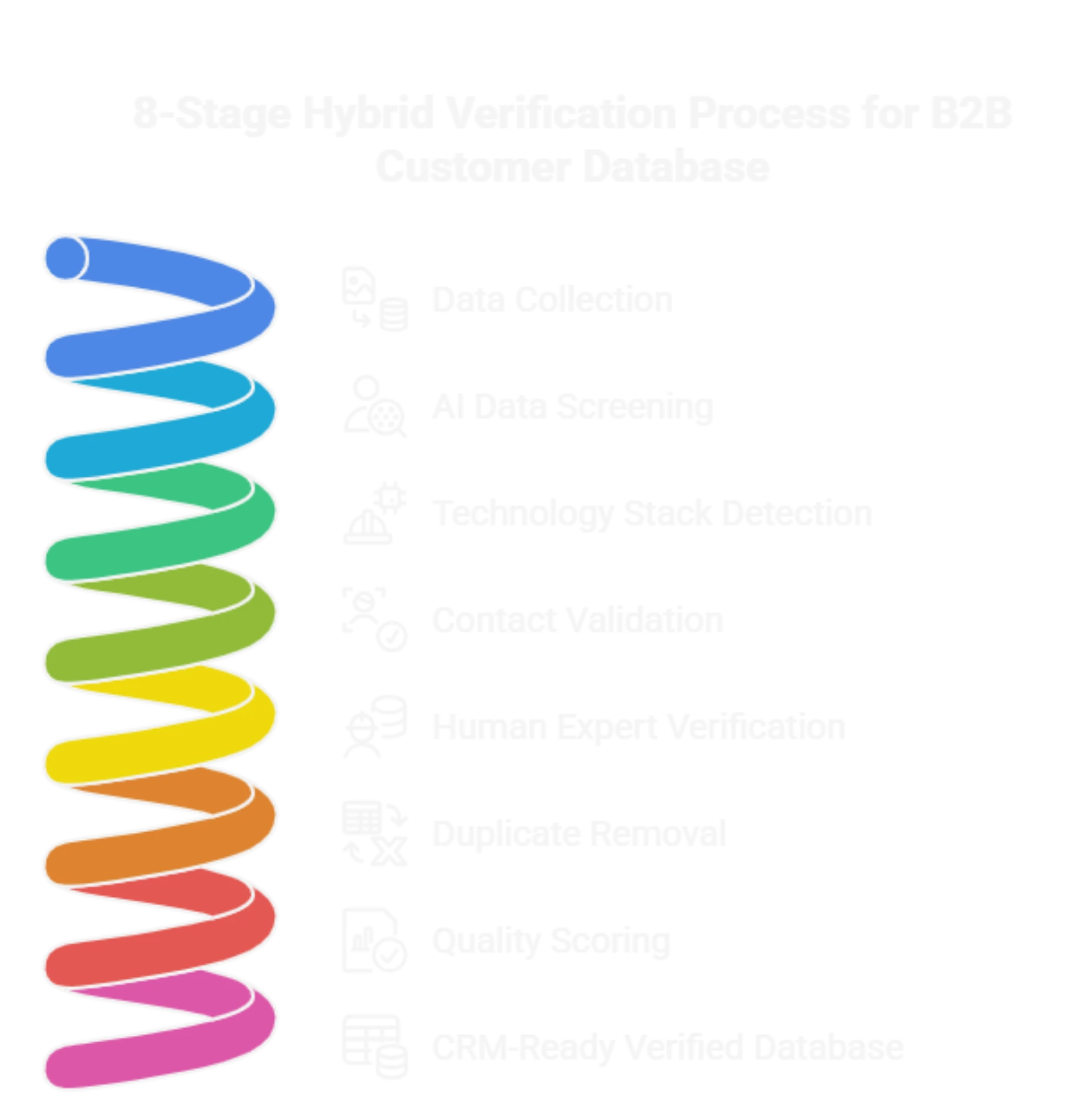
| Verification | Automated/Robotic Scrapers | 8-Stage Hybrid (AI + Human Research) |
| Data Freshness | Static (Decays 3% per month) | 30/60/90-Day Refresh Cycles |
| Customization | Bulk "Off-the-shelf" lists | Tailored to your specific ICP |
| Context | Basic Contact Info | Deep Technographic & Intent Mapping |
Why is B2B Customer Database Accuracy so Important?
Business data changes rapidly. Industry research shows that B2B data becomes outdated at a rate of 30% to 70% every single year. People change jobs, companies merge, and email addresses are deactivated.
When you use an old customer database, sales productivity drops significantly. Sales representatives spend hours calling disconnected numbers, and marketing departments waste their budgets sending emails to inactive addresses.
DCM solves this problem through a strict verification process. We do not just automatically copy data from the internet. We ensure its exact accuracy through specific, measurable steps:
- 8-Stage Verification: We use a combination of artificial intelligence software to check for format errors and human researchers to confirm the details.
- Continuous Refresh Cycles: We update our data on a 30, 60, or 90-day cycle. This guarantees that you are never trying to contact a person who no longer works at that company.
- Strategic Guidance: Our team provides more than just a spreadsheet file. We provide the context and understanding needed to turn that information into a successful sales campaign.
How B2B Teams Use Customer Database?
High-quality B2B data provides a clear advantage for every team in your organisation. When departments have access to verified, detailed information, their performance improves.
Here's how different departments can use a structured database to improve their daily operations and long-term results.
Departmental Data Usage Comparison
| Department | Primary Goal | How They Use the Database | Key Outcome |
|---|---|---|---|
| Marketing | Lower the cost to acquire a new customer. | Target specific accounts based on the technology the account currently uses. | Higher response rates and less wasted advertising spend. |
| Sales | Shorten the time it takes to close a deal. | Review the prospect's current tools and budget before the first phone call. | Better qualifications and more relevant sales presentations. |
| Strategy | Plan entry into new geographic markets. | Analyse competitor market share and company sizes in different regions. | Clear, data-backed plans for future business expansion. |
| Product | Build features that the market actually needs. | Review the most common software programs used by potential customers. | Software integrations that make the product more valuable to buyers. |
Marketing Teams Identify the Right Prospect to Target
Quality data lowers Cost Per Acquisition (CPA) and maximises ROAS. Marketing teams use technographic intelligence to:
- Competitor Displacement: Target competitors' market share for precision switch-and-save campaigns.
- Technographic Filtering: Enhance ABM by targeting only accounts with compatible technology ecosystems.
- ICP Refinement: Redefine ideal profiles based on the real-world tech stacks of your most profitable customers.
- High-Intent Segments: Engage Must-Have Accounts (MHAs) with messaging tailored to their specific digital infrastructure.
Sales Teams Close Deals Faster with Efficiency
Sales cycles are shortened when representatives provide the exact solution prospects are looking for. Detailed technographics allow sales teams to bypass discovery friction:
- Solution Positioning: Tailor pitches based on the prospect's existing tech stack for immediate relevance.
- Financial Qualification: Estimate a lead's budget and authority by analysing their current IT spend and complexity of their tech stack.
- Predictive Opportunity Mapping: Use intent data to identify companies actively researching alternatives to their current vendors.
- BANT Readiness: Ensure the Budget, Authority, Need, and Timeline are largely validated before the first discovery call even begins.
Leadership Teams Identify Market Opportunities
For leadership teams mapping the future of the organisation, a comprehensive database provides a clear view of the TAM, SAM, and SOM landscape:
- Geographic Expansion: Execute step-by-step plans for entering new regions by identifying territories where competitors are under-penetrated.
- Pricing Adaptability: Strategise pricing models by analysing the financial scale and company size of your competitor's clientele.
- Competitive Battlecards: Develop data-backed research to give your team a tactical edge in head-to-head competitive deals.
- Market Share Profiling: Use 360-degree market views to identify opportunities within crowded industries.
Partnership Teams Expands their Channel Ecosystem
Intelligence fuels the growth of your indirect revenue streams by identifying high-potential partners:
- Partner Recruitment: Identify Value-Added Resellers (VARs), MSP vendors, and distributors currently working with your competitors to recruit them into your own channel.
- White-Space Analysis: Discover which industries or regions your competitors' partners are specialising in to find gaps for your own expansion.
- Integration Matrix: Build a complete matrix of technology partners and system integrators to build and maintain a partner ecosystem.
How Demand Curve Marketing Stands Out?
Delivering static lists that are huge but irrelevant is not our thing. DCM treats B2B data as a precision instrument. We not only provide a customer database as per your ICP, but we also become your partner in strategic execution.
Smooth CRM Enrichment & Workflow Integration
Data is only valuable if it is accessible. We eliminate the friction of manual uploads and data silos by ensuring our intel is formatted for immediate use. Whether your team uses Salesforce, HubSpot, or Microsoft Dynamics, our data integrates into your existing environment.
We don't just provide new leads; we enrich your existing records with deep technographic insights. This turns "cold" CRM accounts into high-priority opportunities without requiring your team to adopt new tools or workflows.
Quality Data Curated for Your ICP over Bulk Lists
In a high-stakes GTM environment, a million unverified names is a liability. DCM operates on the principle of Quality Over Volume (now this doesn't mean our list isn't extensive). We collaborate with your team to identify your specific ICP and then curate a list based on those exact parameters.
Access to millions of contacts is meaningless if only a fraction converts. We prioritise precision to ensure your resources are focused on high-probability accounts.
Enterprise deals are rarely won through a single contact. We provide details that help you navigate the entire buying committee. We simplify identifying the technical, financial, and executive stakeholders within your Must-Have Accounts.
Data-Backed GTM Strategy Guidance
DCM stands out by providing more than just a customer list database. We provide the strategic context needed to win. From analysing competitor market share to identifying expansion opportunities in new geographies, our team combines B2B intelligence with tactical guidance.
We don't just give you the "Who", we help you refine the "How" and "When" of your next market-moving campaign.
Conclusion
A highly accurate B2B customer database is one of the most important investments an organisation can make. That's how you add value to your sales and marketing teams. When you choose a specialised provider like Demand Curve Marketing, you secure a distinct advantage over competitors who are still using outdated, unverified lists.
From identifying companies that are unhappy with their current vendors to finding new international markets through partner networks, our customised data gives your team the exact information they need to work efficiently and close larger contracts.
Ready to Transform Your GTM Strategy with High-Accuracy B2B Data?
Get ICP-aligned, human-verified customer database with 97%+ accuracy from DCM's intelligence on 30,000+ technology vendors.
FAQs
1. Who is a B2B database provider?
A B2B database provider collects, verifies, and maintains business contact and company information such as firmographics, technographics, and decision-maker details. Businesses use these databases to identify and engage potential customers more efficiently.
2. Why does your business need a B2B data provider?
A B2B data provider helps companies identify high-fit prospects, reduce time spent on manual research, and target accounts more precisely. This improves lead quality, accelerates sales cycles, and increases marketing ROI.
3. What are the key indicators of high-quality B2B data?
High-quality B2B data typically includes:
- Verified contact details for key decision-makers
- Accurate firmographic data, such as company size, revenue, and industry
- Up-to-date company hierarchies and organisational structures
- Technographic insights showing the technologies a company uses
- Regular data refresh cycles to minimise data decay and outdated records
4. How does Demand Curve Marketing ensure the accuracy of its B2B customer database?
We maintain a high data accuracy through a hybrid verification approach that combines automated data collection with human-in-the-loop validation. The database is refreshed regularly to capture company changes, technology adoption, and updated decision-maker information.
5. How does a B2B customer database help improve ABM?
A B2B customer database allows marketing teams to identify high-value accounts, segment audiences based on company attributes or technology usage, and run personalised campaigns targeting specific decision-makers.
About us
DemandCurveMarketing (DCM) is your dedicated B2B technology growth partner. Our handpicked team of expert technology marketers empowers IT and tech-driven companies to accelerate growth through data-driven strategies and unparalleled market intelligence. We specialize in delivering hyper-targeted audience insights, advanced technographics, precise channel and industry targeting, and comprehensive data enrichment and cleansing solutions—all in one place.
With intelligence on 30,000+ vendors spanning software, hardware, cloud, networking, and emerging tech, DCM helps you deeply understand your Total Addressable Market (TAM), identify high-fit opportunities, and align your outreach and campaigns for optimal impact. Our solutions support companies of all sizes, from ambitious startups to Fortune 500 leaders, ensuring that each client has access to reliable, current, and actionable data for a competitive advantage.
Subscribe to our Technology Marketing Hacks newsletter for tailored insights and growth strategies.
Contact us for any tech or marketing queries: sales@demandcurvemarketing.com
Read our previous newsletter - Webinar & Event Outreach for B2B Tech Companies — How to Fill Seats with Your Ideal Attendees