




How to Build an Effective B2B Ideal Customer Profile (ICP)?
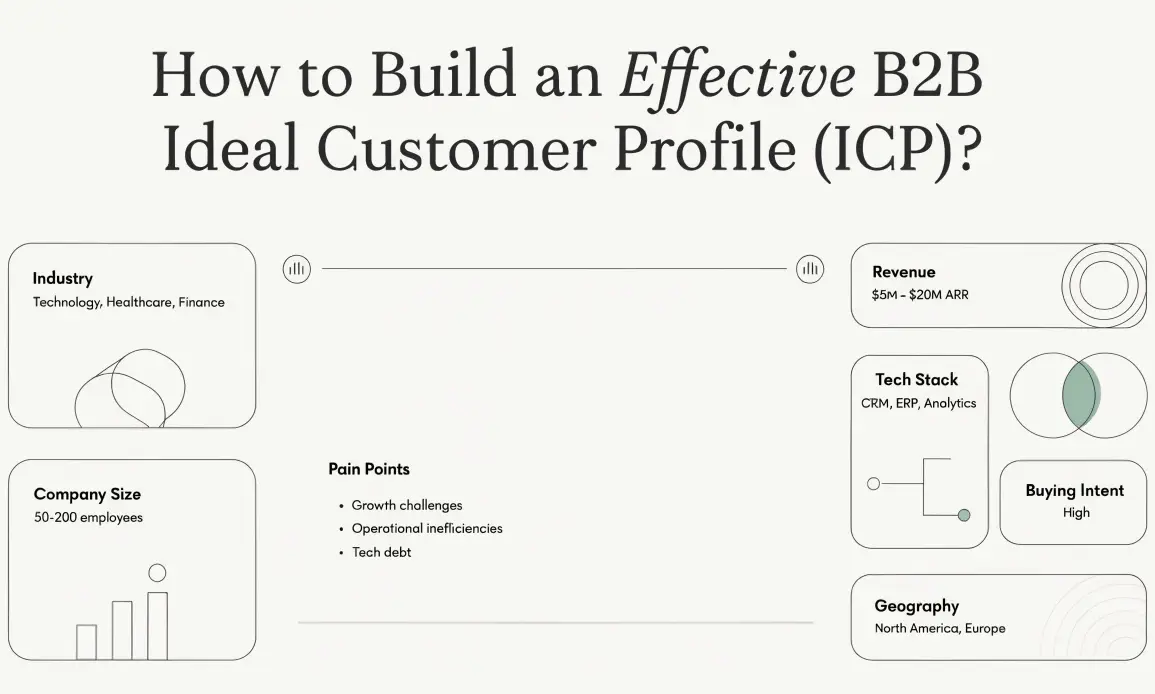
If your sales team is constantly chasing leads that never convert, you're not alone. Many B2B companies try to target everyone and end up connecting with no one in particular. That's exactly where an accurate Ideal Customer Profile B2B strategy becomes mandatory.
Nearly 50% of sales time is wasted on unproductive prospecting, while only a small percentage of marketing-generated leads are actually qualified enough for serious sales conversations. That's a huge amount of time, budget, and pipeline energy being spent on accounts that were never the right fit to begin with.
A well-researched ICP helps solve that problem.
It gives your sales and marketing teams a clear picture of the companies that genuinely benefit from your solution. These are not just any accounts; they are the ones most likely to convert faster, stay longer, and generate meaningful long-term revenue.
What Is an Ideal Customer Profile (ICP)?
A B2B Ideal Customer Profile is a highly detailed, data-driven description of the specific type of organization that derives the maximum value from your product or service.
Rather than acting as a broad list of industries, an ICP acts as a strict filtering mechanism. It aligns your entire revenue engine around the accounts likely to convert faster, stay longer, and generate meaningful long-term revenue.
Here's what an ICP helps businesses with:
- Identifies High-Value Targets: Pinpoints the exact industry, company size, and revenue ranges that match your business model.
- Maps Technology Environments: Highlights the software stack required for an account to adopt your solution successfully.
- Clarifies Business Challenges: Centers your messaging around the specific pain points your product resolves.
- Tracks Buying Intent: Focuses GTM efforts on accounts showing active engagement behavior.
- Maximizes Lifetime Value: Prioritizes businesses that are likely to successfully adopt the tool and remain loyal long-term.
How to Build a B2B Ideal Customer Profile Step by Step?
Building a high-quality B2B Ideal Customer Profile is about analyzing real customer data, sales insights, and technographic intelligence. This helps you identify the companies that consistently yield the highest return on investment.
Here is the framework modern B2B teams use to build and refine a high-performing ICP.
Step 1: Analyze Your Best Customers
Start by reviewing your top-performing customers. Look for the ones who consistently renewed, expanded their accounts, and referred others. Your existing best customers usually reveal the clearest, most accurate picture of who truly benefits from your solution, serving as the foundation for your new targeting matrix.
- Identify Shared Firmographics: Look for overlapping patterns in industry, company size, and geographic location.
- Evaluate Business Models: Pinpoint the operational structures and go-to-market motions your best clients share.
- Measure Success Metrics: Calculate the average time-to-close and historical lifetime value (LTV) for these top-tier accounts.
Step 2: Gather Firmographic and Technographic Data
Go beyond basic company details like revenue and headcount. You must deeply analyze a target company's tech stack. Evaluate if they are operationally ready and technically aligned to implement your solution without heavy friction.
- Audit Digital Infrastructure: Map out the CRM, ERP, and automation platforms currently embedded in their workflows.
- Assess Cloud Maturity: Determine if the company operates on legacy on-premise systems or modern cloud architectures.
- Identify Integration Appetite: Evaluate their historical willingness to adopt and integrate new software tools.
Step 3: Enrich Your Customer Data
Modern B2B teams close that gap by systematically layering in third-party signals and competitive marketing intelligence. This helps build actionable insights around every account worth pursuing.
- Monitor Intent Signals: Track off-site content consumption and spikes in product-related research.
- Analyze Hiring Patterns: Look for newly opened roles or executive leadership changes that indicate a strategic shift.
- Track Financial Milestones: Follow recent funding rounds, acquisitions, or rapid departmental expansions.
Step 4: Identify Common Pain Points
The strongest ICPs are built around real, urgent business problems, not assumptions or product features. You must review past interactions to understand the recurring, costly challenges your product successfully resolves for your buyers.
- Review Sales Conversations: Analyze discovery call transcripts and notes for frequently cited operational bottlenecks.
- Gather Customer Success Insights: Interview onboarding teams to understand the primary friction points new clients are trying to escape.
- Evaluate Support Trends: Look for recurring feature requests and support tickets that highlight overarching industry pain points.
Step 5: Create an ICP Scoring Framework
Not all accounts that fit your profile deserve immediate outreach. Building a structured evaluation system based on your data helps sales and GTM teams prioritize the accounts most likely to close in the current quarter.
- Score Firmographic Fit: Assign baseline points for matching target industries and revenue brackets.
- Weigh Technographic Alignment: Add heavy multipliers for accounts using complementary software (or penalize for hostile tech stacks).
- Factor Engagement Levels: Boost scores for accounts demonstrating active intent, high engagement, and confirmed budget potential.
Step 6: Continuously Refine Your ICP
Your market, product, and customer behavior will inevitably evolve. The most effective ICPs do not remain static documents. They are dynamic assets that require regular auditing using fresh customer insights and market intelligence.
- Schedule Regular Audits: Conduct quarterly reviews with sales, marketing, and product leadership.
- Analyze Win/Loss Data: Incorporate insights from recently closed-won and closed-lost deals to adjust targeting parameters.
- Adapt to Industry Trends: Shift your criteria to account for emerging technologies, economic shifts, or new competitor landscapes.
What are the Key B2B Sales Ideal Customer Profile Criteria?
Not every lead in your pipeline requires the same amount of attention. Some accounts have the structural and financial capacity to convert seamlessly. And there will be others who will drain resources and ultimately churn.
Industry data shows that revenue teams utilizing strict B2B sales Ideal Customer Profile criteria achieve up to 68% higher win rates. Standardizing your qualification around these five signals instantly accelerates pipeline velocity and eliminates wasted discovery calls.
1. Firmographic Fit
Firmographics help you identify whether a company fits your target market. They act as the first qualification layer. Teams usually evaluate industry, company size, revenue, and location. This helps sales teams focus only on accounts that match their ICP before spending time and resources.
2. Technographic Alignment
Technographic data shows a company's tech stack. This helps teams understand whether an account is ready to buy. You can identify their software stack, spot competitor tools, and track migration trends. These insights reveal accounts with a stronger likelihood of switching or integrating new solutions.
3. Intent Signals
Intent data shows which companies are actively researching solutions. It helps teams identify buying interest early. You can track search behavior on review sites, whitepaper downloads, and webinar registrations. These signals often indicate that a company is entering an active buying cycle.
4. Engagement Level
Engagement data measures how prospects interact with your brand directly. It helps identify when interest becomes serious consideration. Strong signals include repeat visits to pricing pages, regular email engagement, and interactions on platforms like LinkedIn.
5. Budget Alignment
Even high-intent accounts may not convert without budget fit. That is why budget alignment is critical. Teams should evaluate purchasing capacity, contract fit, budget cycles, and financial stability. Funding rounds and IPO activity can also indicate stronger buying potential.
Why B2B Data Enrichment for Ideal Customer Profile Development is Important?
Your CRM is only a starting point. Most B2B databases become incomplete or outdated very quickly. Many records also lack the depth needed for accurate ICP development and GTM planning.
B2B data enrichment solves this problem by adding valuable third-party intelligence to your existing account data. It helps fill gaps in firmographics, technographics, and intent data.
This process also reduces data decay and improves record accuracy over time. As a result, marketing and sales teams can identify high-fit accounts faster and build more personalized campaigns using real-time insights.
Conclusion
Your ICP should not stay static once it is documented. High-performing B2B teams continuously refine it using intent signals, win-loss analysis, and customer behavior data.
The real advantage comes when sales and marketing prioritize accounts based on both fit and buying readiness. This approach also strengthens any account-based marketing strategy for B2B SaaS by improving targeting precision and pipeline quality.
Frequently Asked Questions (FAQs)
1. How is an Ideal Customer Profile different from a buyer persona in B2B marketing?
The difference between a buyer persona vs ideal customer profile in B2B is that an ICP focuses on the company level, while a buyer persona focuses on the individual decision-maker. An ICP defines which organizations are the best fit for your solution, whereas personas help personalize messaging for stakeholders within those accounts.
2. What are the most important B2B sales ideal customer profile criteria?
The most effective B2B sales Ideal Customer Profile criteria include revenue potential, technology compatibility, buying readiness, industry alignment, retention likelihood, and expansion opportunities. Many organizations now combine intent signals and technographic insights to improve account targeting accuracy.
3. Why do many B2B Ideal Customer Profiles fail to improve pipeline quality?
Many ICPs fail because they rely on static demographic filters instead of dynamic buying signals and account intelligence. DCM helps businesses refine targeting using intent data, technographic insights, and account-level intelligence to improve conversion efficiency and pipeline quality.
4. How can customer intelligence platforms help businesses identify high-fit accounts?
Customer intelligence platforms help businesses identify accounts that match their B2B Ideal Customer Profile by analyzing factors like technology usage, buying intent, market activity, and engagement trends. DCM combines technographic, firmographic, and intent-based insights to help GTM teams build more precise ICPs and improve ABM performance.
5. How does data enrichment improve B2B ideal customer profile accuracy?
B2B data enrichment for Ideal Customer Profile development helps businesses move beyond basic firmographics by adding intent data, technology adoption insights, and behavioral signals. DCM helps organizations enrich ICPs with real-time customer intelligence, enabling sales and marketing teams to prioritize high-fit accounts more effectively.