




Account-Based Marketing Strategy for B2B SaaS: A Step-by-Step Framework
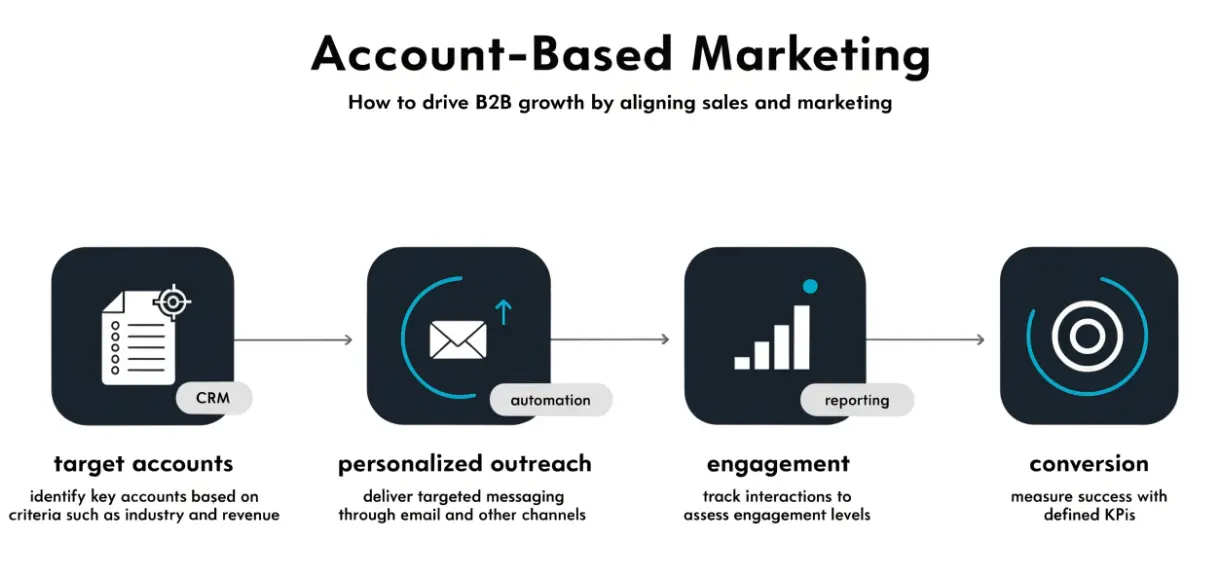
Most B2B SaaS companies waste 60-80% of their marketing budget chasing leads that will never convert. Account-based marketing (ABM) fixes that. Instead of casting a wide net and hoping the right buyers show up, ABM flips the funnel.
You identify the exact companies most likely to buy, then coordinate sales and marketing to win them. According to ITSMA, 87% of marketers say ABM delivers a higher ROI than any other marketing investment. Forrester data shows ABM practitioners see 200% more revenue attributed to marketing compared to non-ABM companies.
ABM isn't optional anymore, it's the playbook.
What Is Account-Based Marketing?
Account-based marketing (ABM) is a strategic B2B growth model. In this approach, sales and marketing teams align to target a specific list of high-value accounts.
Instead of generating bulk leads and filtering them later, teams use personalized outreach, content, and campaigns. It treats each target account as a market of one. To truly understand the engine behind this precision, it helps to look at how technographics help in account-based marketing by providing the digital DNA of your target accounts.
Every touchpoint, from LinkedIn ads and cold emails to sales calls, is built around that company's unique business context. The strategy focuses deeply on their specific pain points and the buying committee.
ABM is not a tool. It's not a campaign type. It's an operating model.
ABM vs. Traditional Demand Generation: Key Differences
| Dimensions | Traditional Demand Gen | Account-Based Marketing |
|---|---|---|
| Targeting | Broad audience segments | Specific named accounts |
| Lead metric | MQLs generated | Pipeline from target accounts |
| Sales-marketing alignment | Loosely coupled | Tightly coordinated |
| Content approach | Generic, persona-based | Account-specific, personalised |
| Time to ROI | Fast (volume-driven) | Slower, higher ACV |
| Best for | PLG, low ACV | Enterprise, mid-market SaaS |
What are the Different Types of ABM (and Which One to Start With)?
ABM 1:1 (Strategic ABM)
Fully custom campaigns for your top 5-20 accounts. Highest cost per account, highest win rates. Best for enterprise deals above $100K ACV.
ABM 1:Few (ABM Lite)
Clustered campaigns for 20-100 accounts grouped by industry, company size, or tech stack. The sweet spot for most mid-market SaaS companies.
ABM 1:Many (Programmatic ABM)
Scaled digital campaigns targeting 100-1,000 accounts using intent data and display advertising. Looks like demand gen but uses account-level targeting logic.
Most B2B SaaS teams should start with ABM Lite. It balances personalization with scale and doesn't require a six-figure tech stack to execute.
Step-by-Step ABM Framework for B2B SaaS
Executing a successful ABM strategy requires a systematic transition from broad targeting to account-level precision. Follow this six-step framework to align your internal resources and build a high-conversion pipeline:
Step 1: Build a Tight Ideal Customer Profile (ICP)
Your ICP is the foundation. Get this wrong, and the rest of the framework falls apart. For those in the IT sector, a key part of this profile involves choosing the right managed service provider that fits your specific ICP maturity.
Pull your top 20 closed-won deals from the last 18 months. Look for patterns across:
- Firmographic data: Company size (employees, revenue), industry, geography
- Technographic data: What tools they use (CRM, marketing stack, data warehouse)
- Behavioral signals: What triggered the purchase? Was there a hiring spike, a funding round, or a product launch?
- Time to close: Which segments close fastest at the highest ACV?
Your ICP is not a persona. It's a company profile. Build it around the accounts, not the individual buyer.
Step 2: Build Your Target Account List (TAL)
Once you have your ICP, build a list of companies that match it. Use a combination of:
- First-party data like CRM contacts, past trial signups, and event attendees.
- Intent data providers to identify accounts researching your category.
- Sales intelligence tools to filter by firmographic and technographic signals.
For ABM Lite, your TAL should be 50-150 accounts. Prioritize accounts showing buying intent signals above all others.
Step 3: Map the Buying Committee
Enterprise and mid-market SaaS purchases involve an average of 6–10 stakeholders (Gartner, 2023). You need to know who they are before you spend a dollar on outreach.
For each target account, map:
- Economic buyer: Approves budget (VP of Marketing, CFO, CRO)
- Champion: Internally advocates for your solution
- End user: Uses the product day-to-day
- Technical evaluator: Reviews security, integrations, compliance
Use LinkedIn Sales Navigator, your CRM, and tools to identify contact-level data within each account.
Step 4: Build Account-Specific Campaigns
This is where ABM earns its ROI. Generic campaigns don't work here. Build content and outreach that speaks to the account's specific context.
For each account cluster (or individual account in 1:1 ABM):
- Write a personalized landing page or microsite referencing their industry or tech stack
- Build a multi-channel sequence: LinkedIn connection → relevant content share → email → LinkedIn InMail → cold call → direct mail (for high-value accounts)
- Create content assets that speak to their specific use case — not just your product category
Example: If you're targeting a Series B fintech company that recently hired a Head of Revenue Operations, your outreach should reference the operational complexity that comes with scaling a RevOps function post-Series B, not a generic "we help companies grow revenue" pitch.
Step 5: Align Sales and Marketing on Account-Level Execution
ABM fails when sales and marketing operate independently. Build a shared account ownership model:
- Assign a named account owner from both sales and marketing for each TAL segment
- Set a shared pipeline goal (not lead volume) as the primary metric
- Hold weekly account review meetings to share signals: who opened what, who clicked where, who engaged on LinkedIn
- Use tools that provide real-time account activity
The playbook is only as good as the handoff. Marketing's job doesn't end at MQL; it ends when the deal closes.
Step 6: Measure ABM Performance at the Account Level
Traditional marketing metrics, CPL, MQL volume, and traffic, are the wrong scoreboard for ABM. Measure at the account level:
| Metric | What it Measures |
|---|---|
| Account engagement score | Overall activity level across all channels |
| Pipeline influenced by marketing | Revenue in pipe tied to ABM touchpoints |
| Account progression rate | % of target accounts moving from awareness → consideration → active opportunity |
| Deal velocity | Time from first touch to closed-won in ABM accounts vs. non-ABM |
| Win rate (ABM vs. non-ABM) | Head-to-head comparison of conversion rates |
Review these monthly at the account level and quarterly at the program level.
What are the Biggest ABM Mistakes B2B SaaS Teams Make?
Even with a proven framework, many B2B SaaS teams struggle to achieve ROI due to execution gaps. Avoid these common pitfalls to ensure your strategy remains a precision-driven revenue engine rather than a generic marketing expense:
- Targeting too many accounts: More accounts = less personalization = worse results. Start with 50–100.
- Treating ABM as a campaign, not a motion: ABM works over a 6–12 month horizon, not a 30-day sprint.
- Measuring in MQLs: If your VP of Marketing is still asking for lead volume, the ABM conversation hasn't landed internally. Fix the metrics before you fix the tactics.
- Skipping sales alignment: Marketing-only ABM is just expensive retargeting. Sales has to own the same accounts.
How DCM Helps B2B Brands for ABM Success?
Demand Curve Marketing transforms ABM from a high-cost experiment into a predictable revenue engine. We specialize in adding a customer intelligence layer of verified technographics to your firmographic data, ensuring your sales and marketing teams focus only on high-intent accounts.
By partnering with DCM, a specialized technographics data provider , you gain access to an 8-stage verification process and a 90-day refresh cycle that ensures:
- Verified Target Account Lists: Skip the data decay of static platforms with curated, CRM-ready lists of decision-makers.
- Technographic Ecosystem Mapping: Identify accounts already running the prerequisite tech stacks for your solution.
- Competitive Intelligence: Pinpoint accounts currently using rival tools to launch high-conversion displacement campaigns.
- Strategic Alignment: We help bridge the gap between marketing outreach and sales execution to maximize deal velocity.
Conclusion
In 2026, the "Account" in Account-Based Marketing is defined by its digital infrastructure. Success requires moving beyond broad firmographics and speaking directly to the technical reality of your prospects.
By implementing a structured framework, from intent-driven ICP definition to account-level measurement, you ensure your ABM strategy is fueled by precision. The result is a more resilient pipeline, an aligned sales-marketing motion, and a significantly higher ROI on every marketing dollar spent.
Frequently Asked Questions (FAQs)
1. What is account-based marketing and how does it differ from inbound marketing?
ABM targets pre-selected high-value accounts with personalized campaigns, while inbound attracts a broad audience to filter later. ABM flips the funnel, prioritizing high-ACV deals and specific alignment.
2. How long does it take to see results from account-based marketing?
Pipeline impact usually appears within 90-120 days. Full revenue attribution takes 6-12 months, as ABM focuses on compounding ROI through larger deal sizes and better retention rates.
3. What account-based marketing metrics should I track?
Prioritize account engagement, pipeline influence, and progression rates. Track deal velocity and win rates against non-ABM accounts. Avoid MQL volume; it misaligns sales and marketing incentives.
4. Can DCM help us select and integrate the right ABM tech stack?
Yes. We help B2B SaaS teams evaluate, select, and integrate ABM tools based on their stage, team size, and budget without recommending tools that add complexity without ROI. We work across the full ABM stack, including intent data providers, sales intelligence platforms, engagement tools, and CRM workflows.
5. How do I identify the best trigger events for ABM outreach?
Effective ABM leverages technographic and behavioral shifts, like a new funding round, a leadership change (VP-level), or the adoption of a competitor's trial tool. These signals indicate a cleared budget and a high-intent window for your solution.
About us
DemandCurveMarketing (DCM) is your dedicated B2B technology growth partner. Our handpicked team of expert technology marketers empowers IT and tech-driven companies to accelerate growth through data-driven strategies and unparalleled market intelligence. We specialize in delivering hyper-targeted audience insights, advanced technographics, precise channel and industry targeting, and comprehensive data enrichment and cleansing solutions—all in one place.
With intelligence on 30,000+ vendors spanning software, hardware, cloud, networking, and emerging tech, DCM helps you deeply understand your Total Addressable Market (TAM), identify high-fit opportunities, and align your outreach and campaigns for optimal impact. Our solutions support companies of all sizes, from ambitious startups to Fortune 500 leaders, ensuring that each client has access to reliable, current, and actionable data for a competitive advantage.
Subscribe to our Technology Marketing Hacks newsletter for tailored insights and growth strategies.
Contact us for any tech or marketing queries: sales@demandcurvemarketing.com