




Your ICP Is Too Broad: Why Sub-Vertical Targeting Beats Industry Segmentation
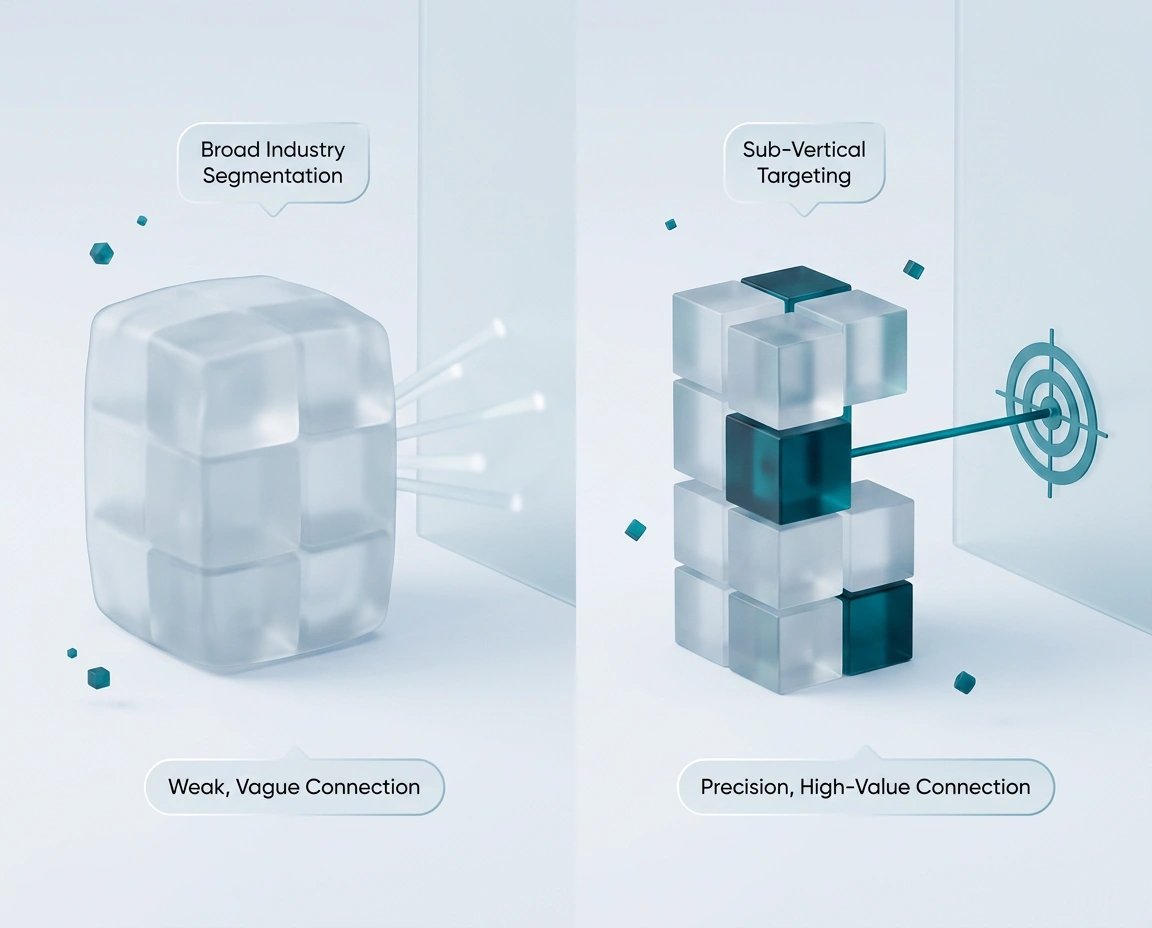
If your outbound feels like it's shouting into a crowd instead of speaking to a person, your ICP is probably the problem. Most B2B teams build audience segmentation around firmographics, industry, headcount, revenue band, geography, and stop there.
It looks organized, but it rarely converts because grouping unrelated businesses under one label flattens the real differences among their buyers, budgets, and pain points.
This blog breaks down why that approach is too broad, how sub-vertical-level target market segmentation fixes it, and how to build a customer segmentation strategy that actually converts.
You'll leave with a practical framework, real market segmentation examples, an account prioritization model, and a clear way to tell when you've gone too narrow versus just narrow enough.
The Problem With Broad Industry Segmentation
Most B2B teams build their ICP around firmographics: industry, headcount, revenue band, and geography. It's a reasonable starting point, but it's also where most segmentation stops. And that's the problem.
When your ICP is "mid-market healthcare companies," you're grouping hospital networks, independent clinics, dental groups, med-tech startups, and health insurance firms under one label. These businesses don't share the same buyers, budgets, workflows, or pain points. Messaging built for one actively repels another.
Broad segmentation also makes personalization nearly impossible. If your sales team can't speak to a prospect's specific operational reality within the first two lines of outreach, you've already lost them. This is exactly why generic audience segmentation produces low reply rates no matter how polished the messaging looks.
Industry Segmentation vs. Sub-Vertical Targeting
Here's the clearest way to see the difference. Sub-vertical targeting is really a sharper form of vertical segmentation. Instead of drawing a line around an entire industry, you draw it around a specific slice of that industry that shares real, repeatable pain points.
| Approach | Example ICP | Problem |
|---|---|---|
| Industry segmentation | Financial services companies | Too broad; covers banks, fintechs, wealth managers, and insurance firms |
| Sub-vertical targeting | RIA firms managing $500M–$2B AUM | Specific buyer, specific pain point, specific message |
| Industry segmentation | Healthcare businesses | Mixes hospitals, clinics, dental groups, and med-tech |
| Sub-vertical targeting | Independent dental groups with 3–10 locations | Clear operational context, predictable buying trigger |
| Industry segmentation | Technology companies | Covers everything from SaaS startups to legacy IT |
| Sub-vertical targeting | Series B SaaS companies scaling a mid-market sales team | Defined stage, defined challenge, defined message |
The narrower ICP doesn't shrink your market as much as you think. It sharpens your ability to win within it, which is the whole point of a real B2B segmentation strategy.
Market Segmentation Examples That Actually Work
Let me walk through three real B2B sub-vertical targeting examples that show this in practice.
Example 1: Cybersecurity Vendor
- Broad ICP: "SMBs in regulated industries"
- Sub-vertical ICP: "Accounting firms with 10–50 employees handling personal tax filings"
- Why it works: This sub-vertical has a specific compliance-related anxiety around client data, a defined busy season that creates urgency, and a peer group that constantly talks to each other. One well-placed case study in an accountant's association newsletter does more than six months of broad outbound.
Example 2: HR Tech Platform
- Broad ICP: "Companies with 100–500 employees"
- Sub-vertical ICP: "Multi-location restaurant groups managing hourly workforce scheduling"
- Why it works: Scheduling complexity, high turnover, and labor law compliance are acute, shared pain points. The buyer, usually an ops director or HR manager, has the same problems regardless of cuisine type or geography. Messaging practically writes itself.
Example 3: B2B SaaS Project Management Tool
- Broad ICP: "Professional services firms"
- Sub-vertical ICP: "Boutique architecture firms billing on a project basis with teams under 30"
- Why it works: This sub-vertical has specific workflow design phases, client approvals, and contractor management that generic project management tools don't address well. A vendor who speaks that language directly wins on resonance, not features.
Customer Profiling at the Sub-Vertical Level
Once you've identified your sub-verticals, customer profiling looks completely different. You're no longer building a generic buyer persona. You're mapping the operational reality of a specific type of business, which is the foundation of any real customer segmentation strategy.
A strong sub-vertical customer profile includes:
| Profile Element | What to Define |
|---|---|
| Business model | How they make money and where margins are tight |
| Buying trigger | What operational event makes them start looking for a solution |
| Internal buyer | Who owns the problem vs. who signs the contract |
| Stack context | What tools are they already using and what integrates with them |
| Peer influences | Which communities, events, or publications shape their decisions |
| Success metric | What "working" looks like to them, not to you |
This level of profiling is what separates vendors who win on resonance from those who win only on price.
Layering in competitive marketing intelligence at this stage also shows how your closest competitors are already speaking to the same sub-vertical. This helps you position around the gaps they're missing rather than repeating their pitch.
Account Segmentation Strategy: A Practical Framework
Knowing your sub-verticals is one thing. Prioritizing accounts within them is another. Here's a simple framework for an account segmentation strategy that keeps your team focused on the highest-fit opportunities:
| Tier | Criteria | GTM Motion |
|---|---|---|
| Tier 1 — Perfect fit | Exact sub-vertical match, right size, known buying trigger, stack compatible | High-touch, personalized outreach, AE-led |
| Tier 2 — Strong fit | Sub-vertical match, slight size or stack variance | Sequenced outreach, SDR-led with AE assist |
| Tier 3 — Possible fit | Adjacent sub-vertical, unconfirmed trigger | Nurture, content marketing, community presence |
| Tier 4 — Poor fit | Broad industry match only | Exclude from active pipeline |
Most teams waste their best reps on Tier 3 and 4 accounts because their ICP is too broad to distinguish between them. Sub-vertical targeting makes Tier 1 and 2 obvious and keeps your pipeline honest.
B2B Segmentation Strategy in Action
Here's how sub-vertical targeting changes the way sales and marketing actually operate day to day:
- Messaging stops being feature-led and becomes situation-led. Instead of "our platform helps teams collaborate," it becomes "accounting firms use us to manage client deliverables across tax season without version control chaos."
- Outbound sequencing gets easier to personalize at scale. When every prospect in a sequence shares the same operational context, one well-written template outperforms fifty generic ones.
- Content marketing gets sharper. A blog post titled "How Independent Dental Groups Can Reduce No-Show Rates" will outperform "Patient Management Tips for Healthcare Businesses" every time in search, social, and email.
- Sales enablement becomes more specific. Reps stop winging discovery calls and start walking in with genuine knowledge of the buyer's world, which builds trust faster than any pitch deck.
When Niche Targeting Makes Sense — And When You've Gone Too Narrow
Niche targeting works when the sub-vertical is large enough to sustain a pipeline and specific enough to have shared, predictable pain points. A good rule of thumb: if you can identify at least 500–1,000 addressable accounts within a sub-vertical, it's worth building a dedicated motion around it.
You've gone too narrow when:
- The sub-vertical has fewer than 200 addressable accounts globally
- The buying trigger is so rare that it doesn't repeat reliably
- The pain point is so niche it requires a completely custom product
In those cases, pull back one level but don't pull all the way back to industry. Find the middle ground between "healthcare" and "three-location urgent care clinics in the Midwest." That's where the real opportunity lives.
Conclusion
Broad ICPs feel safe because they look big on paper. But in B2B, relevance beats reach almost every time. The teams winning today aren't targeting larger markets; they're targeting smarter ones, using sub-vertical precision instead of industry-wide guesswork.
Sub-vertical targeting isn't about shrinking your ambition. It's about focusing it where it compounds fastest. Sharper messaging, higher conversion, stronger retention, and a reputation that spreads through tight-knit peer communities faster than any paid channel can replicate. Combined with disciplined customer profiling and account tiering, it turns scattered outbound into a repeatable, predictable motion.
Start with two or three sub-verticals. Build real profiles. Run a focused motion. Measure what converts. Then expand deliberately from there.
That's not a niche strategy; that's how category leaders are quietly built, one well-chosen sub-vertical at a time.
Frequently Asked Questions
What's the difference between industry segmentation and sub-vertical targeting?
Industry segmentation groups broad categories like "healthcare" or "technology," while sub-vertical targeting narrows in on a specific slice within that industry like "independent dental groups with 3–10 locations" where buyers share the same pain points and buying triggers.
How narrow should a B2B segmentation strategy actually be?
Narrow enough that messaging feels specific to the buyer's world, but broad enough to sustain pipeline. As a rule of thumb, a sub-vertical should have at least 500–1,000 addressable accounts to justify a dedicated go-to-market motion.
Does niche targeting mean giving up on market size?
No. Niche targeting sharpens focus within a market; it doesn't shrink the market itself. Vendors often find they can expand into adjacent sub-verticals once the first one is winning consistently.
How does customer profiling change at the sub-vertical level?
Instead of a generic buyer persona, profiling maps the actual operational reality of a business: its buying triggers, internal stakeholders, existing tech stack, and the specific metric that defines success for that sub-vertical.
How do I prioritize which accounts to target first?
Use a tiered account segmentation strategy: rank accounts by exact sub-vertical fit, size, known buying triggers, and stack compatibility. Tier 1 accounts get high-touch, AE-led outreach, while poor-fit accounts are excluded from active pipeline entirely.