




How to Research Companies for Sales Outreach?
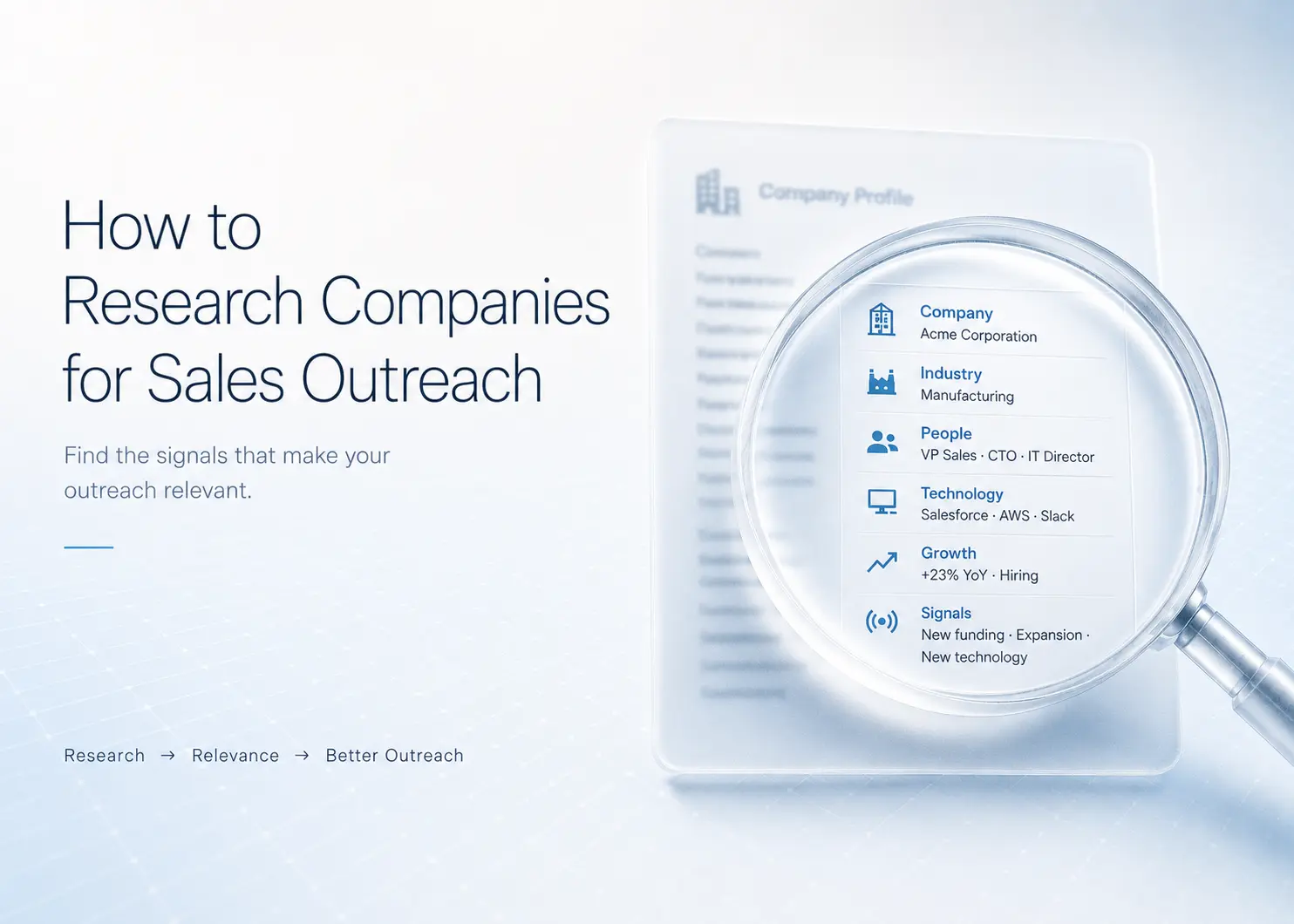
Cold outreach has never been more competitive. According to HubSpot's 2024 State of Sales Report, sales professionals spend only about 30% of their time actually selling. The rest goes into administrative work, prospecting, and research. Meanwhile, buyers increasingly expect outreach to be personalized and relevant from the very first interaction.
Generic pitches that inform your USPs no longer work. To earn a response, you need to understand a company's business, technology stack, recent developments, hiring trends, and buying signals before sending your first email.
The challenge is that spending an hour researching every prospect isn't scalable. It limits the number of accounts you can reach and slows down your pipeline.
This guide shows you how to research companies efficiently, identify high-intent prospects faster, and use actionable insights to create outreach that gets more replies.
TL;DR Summary
- The Problem: Sales reps waste hours Googling prospects manually. This slow research process lowers daily outbound call volumes significantly.
- The Solution: Adopt a fully automated, data-driven sales strategy. Use premium B2B sales intelligence to find deep account insights instantly.
- The ROI: Your reps deliver highly relevant, contextual pitches. You eliminate cold outreach guesswork and easily improve sales win rates.
The Flaw in Manual Company Research
Most reps start by scrolling through LinkedIn. They spend twenty minutes reading recent company news. They desperately look for an opening hook.
This manual approach is totally unscalable. Your top sellers become glorified internet researchers. They spend far less time actually selling. You cannot build a predictable pipeline this way. Manual research yields shallow, public data. It misses the hidden buying signals completely.
What to Look for During Research?
Do not look for generic company trivia. Look for specific business pain points instead. Identify exactly how they operate internally.
Check their firmographics first. Confirm their revenue and employee headcount quickly. Make sure they actually fit your ideal customer profile.
Next, uncover their tech stack. Know what software they currently use. This tells you if your product integrates smoothly.
How B2B Sales Intelligence Helps Improve Outreach?
You need to automate your research process entirely. This is where B2B sales intelligence becomes absolutely critical. It does the heavy lifting automatically.
Modern competitive marketing intelligence platforms (btw we hold the expertise in this) scan millions of data points continuously. They deliver deep account insights straight to your dashboard. Manual scraping becomes totally obsolete.
You instantly see leadership changes and funding rounds. You spot new product launches effortlessly. Your reps gain immediate, actionable context before dialing.
How to Build a Data-Driven Sales Strategy?
Great data requires proper and swift execution. You must build a data-driven sales strategy to succeed. Random outreach based on good data still fails.
Map your insights to specific sales plays. If a company just raised funding, act fast. Trigger a growth-focused email sequence tailored to that buying signal.
If they use a competitor's product, don't send a generic pitch. Use a solid competitor displacement outreach strategy to position your solution at the right moment. Precision targeting consistently outperforms high-volume outreach.
Leveraging Sales Intelligence Data for Timing
Timing is absolutely everything in B2B sales. Pitching a great product at the wrong time fails. You must strike precisely when they need you.
Premium sales intelligence data tracks active buying intent. It shows you when a company is researching your category. Buyers leave digital footprints everywhere today. When a target account reads competitor reviews, you know. You reach out while their pain is fresh. This intercepts their buying journey instantly.
Mapping the Entire Buying Committee
Modern B2B deals involve multiple decision-makers. You cannot just research one single person. You must map the entire buying committee properly.
Identify the end-user who feels the daily pain. Find the technical buyer who evaluates deep integrations. Locate the economic buyer who controls the budget.
A complete account picture requires researching all three roles. Automated tools reveal reporting structures very quickly. This prevents deals from stalling later on.
Monitoring Hiring Trends and Job Roles
Job postings are incredible research goldmines for sales. They reveal a company's strategic roadmap perfectly. A hiring surge indicates aggressive expansion plans.
If they hire multiple Salesforce administrators, note it immediately. It means their CRM usage is scaling rapidly. Pitch your Salesforce integration tools right away.
Hiring data shows you their internal skill gaps. It exposes the software they plan to adopt next. Use this to anticipate their exact needs.
Identifying Important Trigger Events
Trigger events create sudden windows of massive opportunity. A trigger event forces a company to act. You must research and monitor these constantly.
Look for new executive leadership announcements regularly. A new VP of Sales will evaluate new software. They want to make an immediate positive impact.
Track mergers, acquisitions, or massive office relocations. These events disrupt the corporate status quo completely. Disruption is the best time to sell solutions.
How to Improve Sales Win Rates with Research
The ultimate goal is closing more deals predictably. Deep research allows you to act as a trusted consultant. You stop acting like a desperate vendor.
Buyers respect reps who understand their business instantly. You skip the basic qualification questions entirely. You jump straight into solving their unique problems.
This immediate relevance shortens your sales cycle drastically. It builds massive trust early in the process. This is exactly how you improve sales win rates.
Integrating Research Directly Into Your CRM
Your research data cannot live in separate browser tabs. It must flow directly into your CRM smoothly. Salesforce or HubSpot must become your central hub.
Seamless integration saves your sales team countless hours daily. They see the research right on the contact record. They never break their daily outbound workflow.
This drives high CRM adoption across your entire team. Clean data leads to highly accurate revenue forecasting. Your Go-To-Market engine runs incredibly smoothly.
Expert Insight: Avoiding Analysis Paralysis
Too much research can actually hurt your sales velocity. Reps often use research to delay cold calling. This is called analysis paralysis.
"Limit pre-call research to three minutes maximum. Find one strong hook, verify their stack, and call. Perfection is the enemy of outreach."
Automated intelligence platforms solve this problem perfectly. They surface the three most important insights instantly. Your reps dial with total confidence immediately.
Conclusion
Researching companies effectively is a mandatory survival skill today. You cannot rely on slow manual web searches anymore. Transitioning to automated intelligence platforms is the only way forward. When you arm your team with verified data, confidence skyrockets.
They stop guessing and start having meaningful business conversations. Upgrade your research process today and win. Watch your pipeline transform into predictable revenue very rapidly.
Frequently Asked Questions
What is B2B sales intelligence?
It is the automated collection of deep company data. It includes firmographics, technographics data, and buyer intent signals. It replaces manual prospect research completely.
How does sales intelligence data help outreach?
It gives you the exact context before you call. You know their pain points and tech stack instantly. This enables highly personalized and relevant pitching.
How can a data-driven sales strategy boost conversions?
It focuses your effort on accounts showing active intent. You stop calling cold lists blindly. Precision targeting drastically increases your meeting booked rates.
How much time should reps spend researching companies?
Reps should spend no more than three minutes researching. Automated tools should provide the necessary insights instantly. This keeps their daily call volume high.
How does research improve sales win rates?
Deep research builds immediate trust with the buyer. You skip basic questions and solve their problems quickly. This shortens sales cycles and wins deals.