




What Is The Difference Between Firmographics And Technographics?
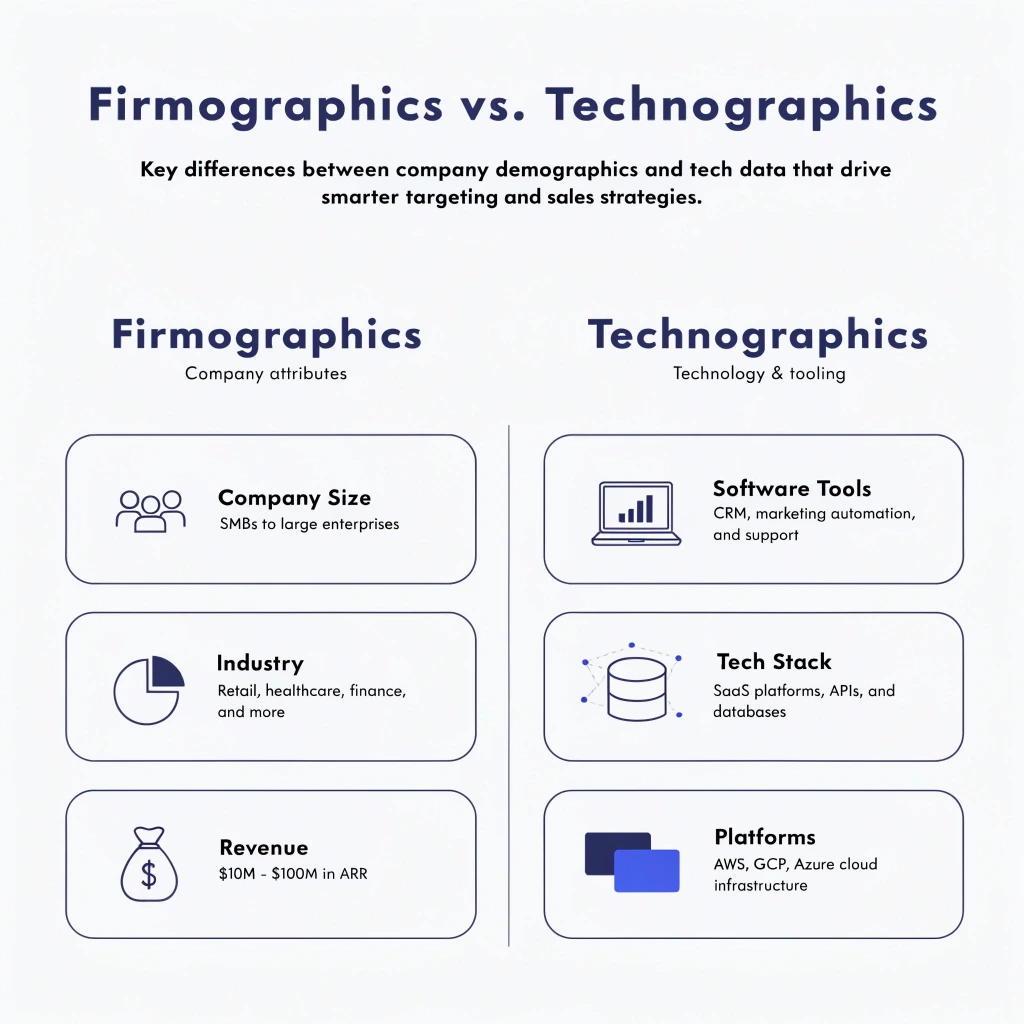
If you are trying to sell a B2B SaaS product, knowing your target audience is non-negotiable. But "knowing your audience" has evolved dramatically over the last few years. If your sales and marketing teams are still building lists based entirely on company size and industry, they are operating with only half the picture.
Modern revenue teams rely on technographic-driven GTM strategies and data quality-focused targeting frameworks to build more accurate pipelines.
To build a high-converting pipeline, you need to understand the fundamental difference between firmographics and technographics, and why modern Demand Gen teams refuse to operate without both.
What Are Firmographics?
Think of firmographics as the demographic data for businesses. It's often used as the first layer before adding technographic intelligence and must-have account targeting strategies . It is the foundational information that categorises organisations into meaningful segments.
Firmographics answer the question: "Who is this company?"
Key firmographic data points include:
- Industry/Vertical: (e.g., Healthcare, FinTech, Manufacturing)
- Company Size: (e.g., 50-200 employees, Enterprise)
- Annual Revenue: (e.g., $10M–$50M)
- Location/Geography: (e.g., North America, EMEA)
- Company Structure: (e.g., B2B, B2C, Non-profit, Government)
If you are selling enterprise-level supply chain software, firmographics ensure you do not accidentally waste your ad spend targeting a 5-person local bakery.
What Are Technographics?
While firmographics tells you who a company is, technographics data dives into the digital DNA of the organisation.
Technographics answer the question: "How does this company operate, and what tools do they use?"
Key technographic data points include:
- The Tech Stack: The specific CRM, marketing automation, cloud infrastructure, or HR software a company is currently running.
- Adoption Stage: Are they early adopters of cutting-edge AI, or are they laggards still relying on legacy, on-premise servers?
- Ecosystem Integrations: How complex is their digital environment? Do they use all-in-one suites or dozens of fragmented point solutions?
If you sell a native Salesforce integration, technographics ensure you are only spending money to target accounts that actually use Salesforce.
Firmographics vs. Technographics: Quick Comparison Table
To clearly understand how these two data sets interact, here is a breakdown of their primary differences:
| Feature | Firmographics | Technographics |
|---|---|---|
| Primary Focus | The organisational structure and financial scale of a business. | The digital infrastructure and software ecosystem of a business. |
| Core Question Answered | Who is the ideal company? | What tools do they use to run their business? |
| Data Volatility | Low. Company size and industry change slowly over time. | High. Tech stacks change frequently as contracts renew and new tools are adopted. |
| Strategic Use Case | Building broad Total Addressable Market (TAM) lists and assigning sales territories. | Identifying competitive displacement opportunities and personalising outreach based on integration needs. |
| Main Limitation | Cannot tell you if a prospect's technology is compatible with your product. | Cannot tell you if a prospect has the budget or headcount to afford your product. |
How to Use Firmographic and Technographic Data to Build GTM Strategies?
Building an effective GTM strategy requires more than identifying who your buyers are. High-performing teams first define TAM, SAM, and SOM opportunities , then combine firmographic and technographic signals to align sales and marketing and prioritise high-intent accounts.
Here's how you can use both together to build a stronger GTM strategy:
1. Define Your Ideal Customer Profile (ICP)
Start with firmographic data to identify companies that match your ideal customer profile. This typically includes:
- Industry
- Company size
- Revenue range
- Geography
This helps you narrow down your Total Addressable Market (TAM) and focus only on high-fit accounts.
2. Apply Technographic Segmentation
Once your ICP is defined, layer technographic data to refine your targeting further. Technographic segmentation helps you identify:
- Companies using competitor tools
- Businesses that require specific integrations
- Accounts adopting complementary technologies
- Organisations ready for technology upgrades
This level of segmentation allows you to move from broad targeting to precision-based GTM strategies.
3. Prioritise High-Intent Accounts
Combining firmographic and technographic signals helps sales teams prioritise accounts more effectively. For example:
- Mid-market SaaS companies (Firmographic)
- Using HubSpot and migrating to AWS (Technographic)
These accounts are more likely to convert and should be prioritised for outreach.
4. Personalise Messaging and Outreach
Technographic insights allow you to tailor messaging based on a prospect's existing tech stack. This enables:
- Integration-focused messaging
- Competitive displacement positioning
- Use-case-based outreach
Personalised outreach improves engagement and increases conversion rates.
5. Align Sales and Marketing Teams
Using both firmographic and technographic data creates alignment between marketing and sales by:
- Improving lead qualification
- Reducing low-fit leads
- Accelerating sales cycles
- Increasing pipeline efficiency
When used together, firmographic and technographic data transform GTM strategies from broad targeting to highly targeted, conversion-focused campaigns.
Why Do You Need Both Firmographic And Technographic Data?
Using one without the other is a recipe for high Customer Acquisition Costs (CAC) and frustrated sales reps.
Imagine you only use firmographics. You target "Mid-market HR agencies." You spend weeks nurturing a lead, get them on a discovery call, and finally realise their legacy database is completely incompatible with your modern cloud solution. That is wasted time.
Now, imagine you combine them. You target: "Mid-market HR agencies (Firmographic) that are currently using Workday and migrating to AWS cloud environments (Technographic)." Your messaging is instantly tailored, your sales team knows exactly which integrations to highlight, and you close the deal in half the time.
What Are The Best Firmographic And Technographic Data Sources?
Acquiring this intelligence requires moving beyond basic LinkedIn searches. The most reliable firmographic and technographic data sources utilise a mix of public records, digital footprints, and human verification.
- Public Financials & Registries: Great for firmographics (revenue, employee count).
- Website Code & Network Scanning: Web scrapers and AI tools analyse site code to identify active marketing automation tools, analytics trackers, and hosting environments.
- Job Board Analytics: Tracking a company's job postings. If an organisation is suddenly hiring five "Marketo Administrators," that is a massive technographic signal.
- Direct Market Surveys: Human-verified phone and email surveys are the gold standard for uncovering back-end legacy systems that cannot be scraped from a website.
Conclusion
Managing raw data from dozens of different sources is chaotic. This is why top-performing B2B enterprises rely on dedicated solutions offering firmographic and technographic insights to enrich their CRM automatically.
At Demandcurve Marketing (DCM), we understand that data accuracy is the lifeblood of your pipeline. We don't just hand you a generic list. We scan over 3 billion public records annually and utilise a rigorous, multi-layered verification process (both AI-driven and human-in-the-loop) to deliver 100% contractually guaranteed data confidence.
By partnering with experts who provide an exclusive B2B customer database , your marketing team can start launching hyper-targeted, high-converting campaigns that speak directly to your buyer's exact operational reality.
FAQs
1. What is the difference between firmographic and technographic data?
Firmographic data describes company attributes like size, industry, and revenue, while technographic data reveals the technology stack and software a company uses.
2. Why do B2B teams need both firmographic and technographic data?
Firmographics confirm ICP fit while technographics reveal operational maturity and integration requirements. Together, they enable precise account targeting and qualification.
3. How can firmographic and technographic data improve GTM strategy?
Combining both helps identify high-fit accounts, prioritise outreach, personalise messaging, and accelerate pipeline growth with better targeting accuracy.
4. How does Demand Curve Marketing provide firmographic and technographic insights?
Demand Curve Marketing combines multi-source data, AI-driven analysis, and human verification to deliver accurate firmographic and technographic intelligence for GTM teams.
5. Can DemandCurve Marketing help build targeted account lists using firmographic and technographic data?
Yes, DCM helps businesses build highly targeted account lists based on firmographics, technographics, and buying signals to improve conversion rates.
About us
DemandCurveMarketing (DCM) is your dedicated B2B technology growth partner. Our handpicked team of expert technology marketers empowers IT and tech-driven companies to accelerate growth through data-driven strategies and unparalleled market intelligence. We specialize in delivering hyper-targeted audience insights, advanced technographics, precise channel and industry targeting, and comprehensive data enrichment and cleansing solutions—all in one place.
With intelligence on 30,000+ vendors spanning software, hardware, cloud, networking, and emerging tech, DCM helps you deeply understand your Total Addressable Market (TAM), identify high-fit opportunities, and align your outreach and campaigns for optimal impact. Our solutions support companies of all sizes, from ambitious startups to Fortune 500 leaders, ensuring that each client has access to reliable, current, and actionable data for a competitive advantage.
Subscribe to our Technology Marketing Hacks newsletter for tailored insights and growth strategies.
Contact us for any tech or marketing queries: sales@demandcurvemarketing.com