



How to Build a Targeted List of Companies Using SAP ERP
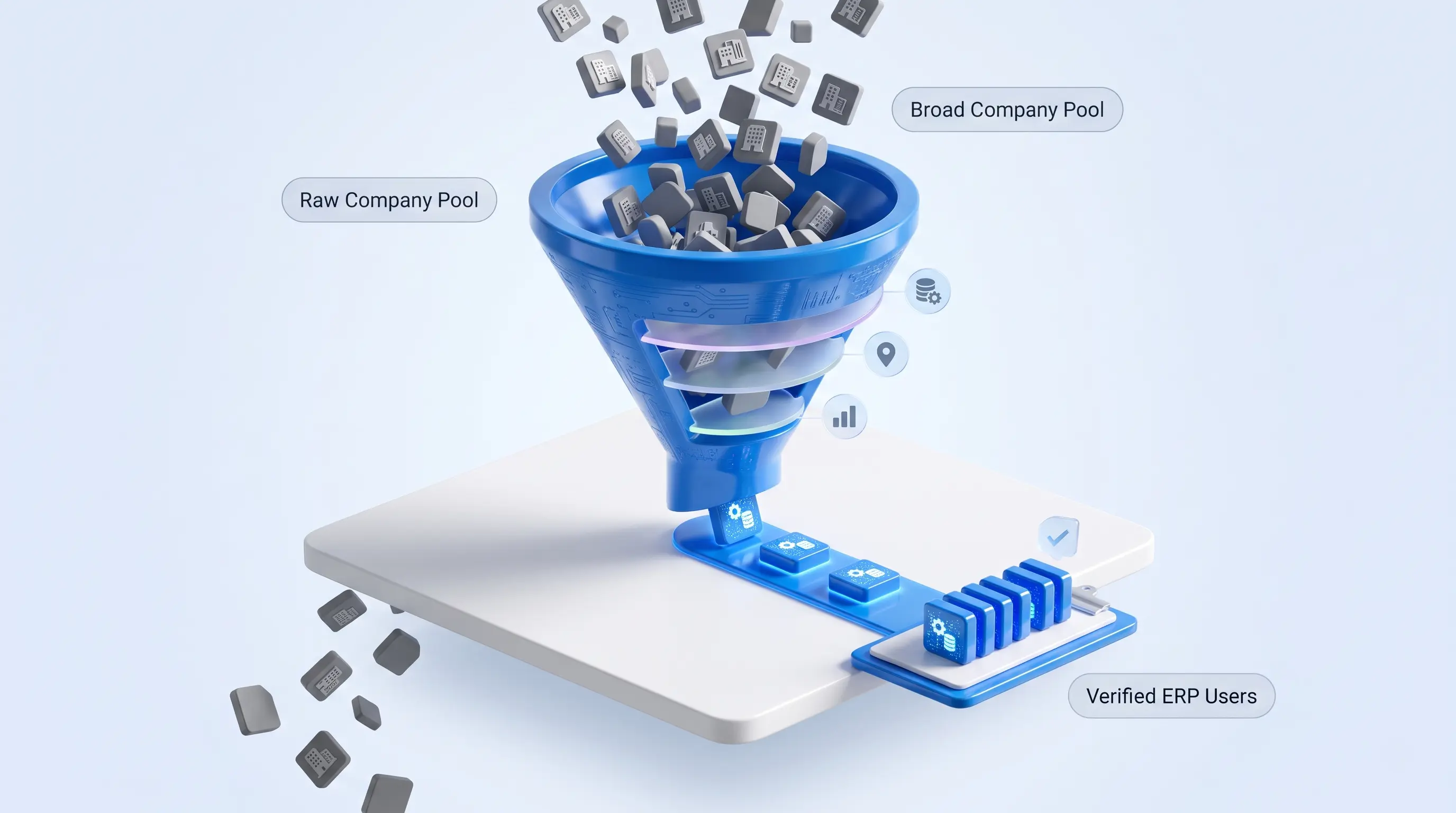
Companies using SAP ERP are some of the most valuable accounts in B2B tech. They tend to be large, operationally complex, and in the middle of costly modernization decisions. That makes them prime targets for ERP consultants, integration and data vendors, cloud and security providers, and SAP add-on makers.
The catch is that a generic list of "SAP users" rarely converts. SAP sells several ERP products, and public user counts disagree wildly. Many lists also mix real end users with the consultancies that implement SAP for them.
This guide shows you how to build an accurate, segmented list of companies using SAP ERP: which companies run it, how to segment by version, where the data comes from, and what to check before you buy contacts.
Key Takeaways
- SAP ERP 6.0 leaves mainstream maintenance at the end of 2027, so many SAP customers face migration decisions now.
- Segment by product and version (ECC, S/4HANA, Business One) before anything else. Each points to a different buyer and budget.
- Remove SAP implementation partners and consultancies from your list. They show up as SAP users but rarely buy like one.
- Verified, version-tagged data beats raw counts. Ask any provider how installs are confirmed and dated.
Need a verified list of SAP ERP customers?
Get technographic data on SAP ERP users, filtered by version, industry, region, and company size.
Why Companies Using SAP ERP Are High-Value Targets Right Now
SAP's own maintenance timeline is creating a buying window. According to ASUG, the Americas' SAP Users' Group, mainstream maintenance for SAP ERP 6.0 enhancement packages 6, 7, and 8 runs until December 31, 2027. After that, customers can buy extended maintenance until December 31, 2030.
Meanwhile, CIO.com reported that SAP committed to supporting SAP S/4HANA until the end of 2040. For many SAP customers, that means planning, funding, and staffing a migration over the next few years.
SAP has acknowledged the pressure on migration resources, and it relies on partners and service providers to meet it. Speaking to CIO.com about migration support when the deadline was extended, SAP's then co-CEO Christian Klein said:
"The demand is high, but the partners now are ramping up as we speak."
Every stage of that journey creates demand:
- Assessment and planning: migration consultants, process mining, and readiness tools
- Migration: data migration, testing, integration, and change management services
- Infrastructure: cloud hosting, managed services, and security
- Post-migration: analytics, automation, and SAP-compatible add-ons
These accounts also have the budget to act. DCM's customer data on companies that use SAP ERP shows that 60% have annual revenue above $1B and another 30% fall between $100M and $1B. Most are enterprises with complex supply chains, global finance operations, and multi-entity structures.
What Companies Use SAP ERP?
If you're asking what companies use SAP ERP, the short answer is large, process-heavy enterprises. Well-known users include BMW Group in automotive, Lockheed Martin in aerospace and defense, and Nestlé in food and beverage.
DCM's mySAP ERP customer data shows where adoption concentrates by industry:
| Industry | Share of SAP ERP customers |
|---|---|
| Manufacturing | 38% |
| Consumer goods | 18% |
| Automotive and aerospace | 15% |
| Chemicals and pharma | 12% |
| Energy and utilities | 10% |
| Others | 7% |
These industries share the same needs: regulatory compliance, batch traceability, multi-site manufacturing, and global supply chains.
Which Companies Use SAP ERP, by Product?
When you research which companies use SAP ERP, remember that "SAP ERP" covers several products with very different customers. Segmenting by product is the single biggest improvement you can make to a target list.
| SAP product | Typical customer | Why it matters for targeting |
|---|---|---|
| SAP ERP 6.0 / ECC (SAP Business Suite) | Large enterprises on legacy on-premises systems | Facing the 2027 maintenance deadline; strongest migration play |
| SAP S/4HANA | Enterprises that have migrated or are mid-migration | Buying add-ons, analytics, automation, and optimization |
| SAP Business One | Small and midsize businesses | Different budgets and buyers; often managed by partners |
A company listed simply as an "SAP user" could sit in any of these groups. Selling S/4HANA migration services to a Business One customer, or SMB add-ons to a global ECC estate, wastes both budget and credibility.
How to Build a Targeted List of Companies Using SAP ERP
Follow these seven steps to turn a broad SAP universe into a list your sales and marketing teams can act on.
Step 1: Define the Play
Start with why you're targeting SAP customers. A migration consultancy, an SAP add-on vendor, a competing ERP, and a channel program each need a different list. Write down the one outcome the list must support.
Step 2: Choose the SAP Product and Version
Decide whether you need ECC, S/4HANA, Business One, or a mix. If your play depends on the 2027 deadline, you need ECC users specifically, not everyone who has ever touched SAP.
Step 3: Layer In Firmographics
Narrow by industry (SIC or NAICS), revenue band, employee count, and region. A manufacturer with $500M in revenue in the Midwest needs different messaging than a global pharma group.
Step 4: Remove the Noise
This phase is where most lists fail. SAP implementation partners, IT consultancies, staffing firms, and SAP itself all show strong SAP signals, so some public directories rank IT consultancies among the top SAP users. Unless you sell to partners, exclude them.
Step 5: Add Decision Makers by Title
Map the buying group to your offer. Common SAP buyers include CIOs, VPs of IT, ERP program directors, SAP Basis leads, enterprise architects, and, for finance modules, CFOs and controllers.
Step 6: Verify and Date Every Record
Confirm that each install is current and tagged by version. A record showing SAP from five years ago may now be an S/4HANA account, or a company that switched ERPs entirely.
Step 7: Activate and Refresh
Push the list into your CRM, launch the campaign, and schedule refreshes. SAP estates change quickly during migration periods, so a list built once and never updated loses accuracy fast.
Skip the manual research.
DCM builds customized SAP ERP customer lists, enriched with verified contacts, firmographics, technographics, and intent signals.
Where SAP ERP User Data Comes From
Search for a list of SAP users, and you'll find public directory pages claiming anywhere from a few hundred to several hundred thousand companies. They aren't all wrong. They're counting different things: every SAP product versus one ERP version, a single mention versus a confirmed install.
Knowing how each source works tells you what your list can and can't see.
| Data source | What it finds well | What it misses |
|---|---|---|
| Job postings | Companies actively hiring SAP skills; live S/4HANA projects | Stable installs with no hiring; consultancies posting for client work |
| Customer stories and press releases | Confirmed, named customers | Only a small, mostly large and positive sample |
| Website crawling | Customer-facing SAP tools, such as commerce storefronts | ERP runs behind the firewall, so core installs rarely show |
| Surveys and user communities | Confirmed installs, versions, and active users | Needs ongoing research effort to scale |
| Technographic data providers | Scale, filters, and contacts in one place | Quality varies with how each provider sources and verifies. |
The most reliable lists combine several of these methods and verify the result. DCM's approach follows that model. It uses an eight-stage methodology that includes real-time web inspection, survey-led validation by email, social and phone, AI sorting by product version, and listening to technology user communities and conferences.
DCM currently tracks more than 40,000 groups using mySAP ERP and backs its technographic data with a 100% contractual guarantee of technographic confidence.
Buying an SAP ERP Users Email List: What to Check
An SAP ERP users email list can shortcut weeks of research, but only if the data holds up. Before you buy, ask the provider to show you:
- Version tagging: Can you filter ECC, S/4HANA, and Business One users separately?
- Install dating: Does each record show when SAP was detected and last verified?
- Exclusions: Are implementation partners and consultancies removed or flagged?
- Contact verification: How are emails and titles validated, and how often?
- Title relevance: Can you target the personas who actually buy, such as ERP program owners and IT leaders?
- Refresh cadence: How often is the list updated as companies migrate?
- Compliance: How is contact data sourced, and how are opt-outs handled?
Compliance deserves attention. The UK ICO's business-to-business marketing guidance confirms that UK GDPR applies whenever personal data is used for direct marketing, even in a business context. In the US, the California Attorney General's CCPA guidance sets out obligations for handling California residents' personal information.
DCM's SAP ERP users email list is continuously refreshed using technographic monitoring, buyer intent signals, AI validation, and human verification, so you're working from current installs rather than stale records.
See the data before you commit.
Request a sample of DCM's SAP ERP users' email list, built to your version, industry, and region criteria.
Campaign Plays for Companies Using SAP ERP
Once your list is built, match the message to the segment:
- ECC users facing 2027: Lead with migration readiness, timelines, and risk reduction.
- S/4HANA customers: Pitch optimization, analytics, automation, and SAP-compatible add-ons.
- Business One users: Focus on growth, integration, and partner-delivered services.
- SAP partners and consultancies: If you run a channel program, this "noise" becomes your target list for partner recruitment.
Conclusion
A strong list of companies using SAP ERP starts with a clear play, segments by product and version, removes consultancies, and verifies every record. Skip those steps, and even a list of thousands of SAP accounts will underperform.
With SAP ERP 6.0 mainstream maintenance ending in 2027, you can now reach these accounts while they make decisions. DCM gives you verified, version-level SAP ERP customer data, including the contacts and firmographics you need to act on it.
Reach SAP ERP decision makers before your competitors do.
Get a customized SAP ERP customer list built around your ideal customer profile.
Frequently Asked Questions
Which companies use SAP ERP?
SAP ERP is used mainly by large enterprises in manufacturing, consumer goods, automotive, aerospace, chemicals, pharma, and energy. Well-known users include BMW Group, Lockheed Martin, and Nestlé.
How many companies use SAP ERP?
Estimates vary because sources count different SAP products and use different detection methods. DCM currently tracks more than 40,000 groups using mySAP ERP.
What's the difference between SAP ECC and SAP S/4HANA for targeting?
ECC is SAP's legacy ERP, with mainstream maintenance ending in 2027, so its users are migration prospects. S/4HANA customers have moved to SAP's current platform and are better targets for add-ons and optimization.
Can I buy an SAP ERP user email list?
Yes. Look for a provider that tags records by SAP version, dates each install, removes consultancies, and verifies contacts regularly. Always request a sample before you buy.
Is it legal to email contacts at companies using SAP ERP?
B2B email outreach is generally permitted, but privacy laws such as UK GDPR and CCPA still apply to personal data. Ask your provider how contacts are sourced and how opt-outs are handled.