



Why Apollo and ZoomInfo Aren't Enough for Technology Companies?
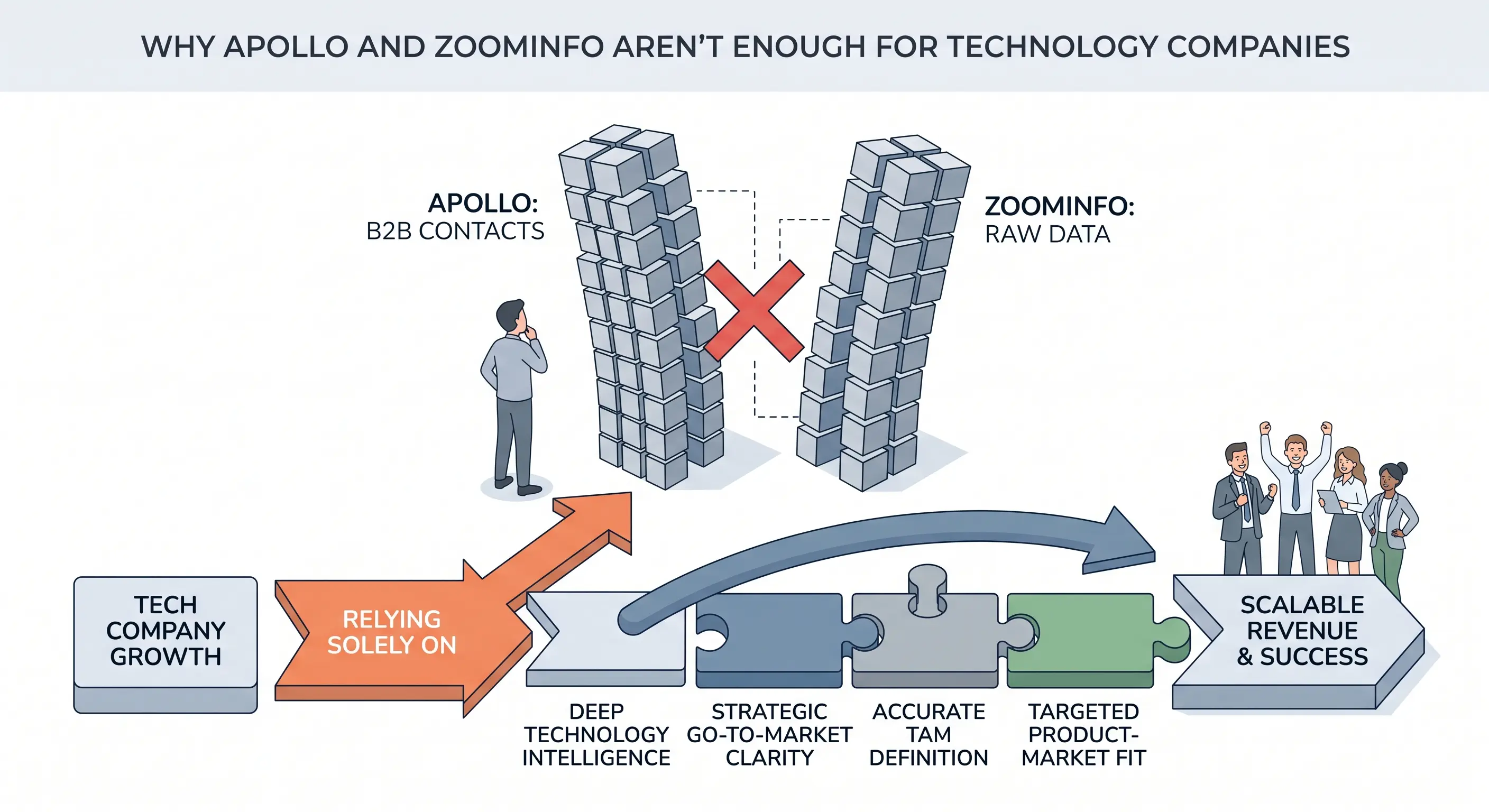
ZoomInfo enriches firmographics with company size, industry, and revenue data, while Apollo focuses on contact intelligence and scalable prospecting. Because both platforms are widely used in B2B GTM workflows, many technology companies already appear in one or both datasets.
But for technology companies selling into vertical markets, manufacturers, healthcare providers, law firms, MSPs, both platforms hit a ceiling fast. That ceiling sits exactly where the real revenue lives. If you've been searching for ZoomInfo alternatives or Apollo alternatives that go deeper than contact data and basic firmographics, you're asking the right question.
The best ZoomInfo alternatives and best Apollo alternatives aren't replacements. They're depth layers. Intelligence that sits on top of the platforms you already use and fills the gaps that matter most in vertical selling.
This blog breaks down the four specific gaps hurting technology vendors most and what smarter intelligence looks like when you layer it on top of what you already have.
What Apollo and ZoomInfo Were Built For?
Before looking at the gaps, it's worth recognising what these platforms do well.
For companies running horizontal ICP campaigns, both platforms deliver significant reach. That's also why searches for ZoomInfo alternatives, Apollo.io alternatives, and even the best alternatives to ZoomInfo have become more common. It's not because the platforms fail, but because teams eventually outgrow the use case they were designed for.
The limitation appears when targeting becomes more specialised.
Both platforms prioritise broad market coverage over deep vertical visibility. Data freshness varies as contacts change roles, technographic signals depend heavily on public sources, and intent models perform best in categories with strong digital footprints.
For enterprise and horizontal SaaS outreach, that works well. For niche industries or operational software targeting, coverage can become thinner and less actionable.
The Four Data Gaps That Stop Technology Vendors From Closing the Right Accounts
Apollo and ZoomInfo work well for broad prospecting. But when technology vendors move into vertical markets, four gaps start limiting targeting quality.
Gap 1: Detection ≠ Actual Usage
Knowing a company uses a platform is rarely enough. Technology vendors need stack-level context: product edition, modules deployed, integrations, adoption maturity, and operational pain points.
"Uses SAP" doesn't explain whether the opportunity sits in ERP migration, manufacturing workflows, or integration gaps. Detection shows presence. It doesn't show how the software is actually being used.
Gap 2: Stack Changes Happen Before Data Updates
Vertical buyers rarely announce software decisions publicly. ERP replacements, EHR migrations, and operational platform changes often happen quietly.
By the time enrichment platforms detect the change, evaluation is finished, and implementation has started. For vendors trying to engage pre-RFP, delayed signals mean missed opportunities.
Gap 3: Coverage Drops in Vertical Markets
Large data platforms perform best where digital footprints are strongest: enterprise and horizontal SaaS.
Coverage becomes thinner in specialised industries where buying decisions happen inside operations, not marketing. The deeper the vertical software stack, the harder it becomes to find reliable account and technographic visibility.
Gap 4: Everyone Is Working From the Same List
When competitors use the same databases, targeting starts to look identical: same accounts, same contacts, same messaging.
The result is commoditised outreach. The advantage shifts from who has more records to who has better signals.
What Real Technographic Intelligence Looks Like?
The goal isn't to replace what you already use. It's to layer the right depth on top of it.
For technology vendors going to market across verticals, that depth means five things:
- 1. Stack composition, not just stack presence. Knowing the specific product, modules, deployment model, and adjacent tooling, not just "uses an ERP."
- 2. Vendor transitions and recency signals. Who just moved off their incumbent platform. Who's renewal-fatigued? Who was just hired specifically to fix the stack. These are the accounts in motion, and motion is what creates buying moments.
- 3. Vertical-specific stack depth. Not horizontal SaaS detection. The specialised operational software that actually runs the businesses you sell into. Manufacturing ERP modules. EHR variants in healthcare. Practice management in legal. RMM and PSA combinations in MSPs.
- 4. Ecosystem and partnership signals. Certifications, margin partners, vertical specialisations, and sub-vertical focus are especially critical for vendors selling through and to the channel.
- 5. Coverage where the big platforms are thin. Privately held vertical operators under 500 employees, regional players, ecosystem partners. These accounts are systematically underweighted in standard databases, and they often close fastest because nobody else is calling them with the right specifics.
How Demand Curve Marketing Fills the Gap?
DCM gives technology vendors the core data they already expect: firmographics, contact data, and account intelligence. And it adds the depth missing in broad prospecting platforms.
Built for vertical markets, we strengthen existing workflows with richer technographics data, earlier transition signals, and continuously refreshed insights. Instead of showing only that a tool exists, it provides deeper visibility into stack composition, adoption, and buying movement.
The result: better targeting, stronger account prioritisation, and a more qualified pipeline without changing your existing stack.
The Practical Stack for Vertical GTM
If you're a technology vendor running outbound or ABM into vertical buyers, here's the layering that actually works:
| Layer | What It Does | Where DCM Fits |
|---|---|---|
| Layer 1 — Breadth | Contact coverage, basic firmographics, and a wide top of funnel | Your existing data platform |
| Layer 2 — Depth | Stack detail, transition signals, niche vertical coverage | DCM |
| Layer 3 — Signal | Leadership changes, RFPs, funding events, hiring signals | Intent layer |
| Layer 4 — Execution | Sequencing, deliverability, CRM hygiene | Outreach infrastructure |
Most teams have Layers 1 and 4 sorted. The pipeline problem almost always lives in 2 and 3.
Conclusion
Standard data platforms are excellent foundational tools. They're not the reason your outbound has plateaued, but they're not enough on their own if you're a technology company selling into vertical markets.
The vendors winning in 2026 aren't the ones with the biggest contact databases. They're the ones with the deepest, freshest, most specific signal on what's actually happening inside their target verticals and the discipline to act on that signal before everyone else even sees it.
If your current data only supports volume-and-spray outbound, there's a much sharper way to run this. The right intelligence layer makes the platforms you already have significantly more productive without adding complexity or replacing what's already working.
Frequently Asked Questions
Why aren't Apollo and ZoomInfo enough for vertical B2B selling?
Both platforms are built around horizontal SaaS categories and enterprise accounts. For vertical markets, manufacturing, healthcare, legal, and MSPs, the stack-level detail, recency signals, and niche coverage don't exist at the depth vertical selling requires.
What is technographic intelligence, and how is it different from firmographic data?
Firmographic data tells you a company's size, industry, and revenue. Technographic intelligence tells you what they run — specific software, modules, deployment models, and integration gaps. For tech vendors, technographics determine fit far more accurately than firmographics alone.
What does "stack composition" mean, and why does it matter?
Stack composition means knowing not just that a company uses a tool, but which version, which modules, how it's deployed, and what sits alongside it. A manufacturer "using SAP" and one "running SAP ECC with no formal MES and a recent Digital Transformation hire" are completely different conversations.
Why is data freshness so critical for vertical technology vendors?
Vertical buyers don't publicly announce stack changes. By the time a transition appears in standard enrichment data, the buying decision is already made. Recency signals — who just switched platforms, who's renewal-fatigued, and who hired to fix the stack — get you into conversations before your competitors do.
How does Demand Curve Marketing work alongside existing data platforms?
DCM isn't a replacement. It's the vertical-specific intelligence layer that sits on top, providing stack depth, transition signals, MSP and VAR ecosystem data, and niche coverage in categories where standard databases are consistently thin.