



Ways to Find Companies That Use Salesforce (But Want to Switch)
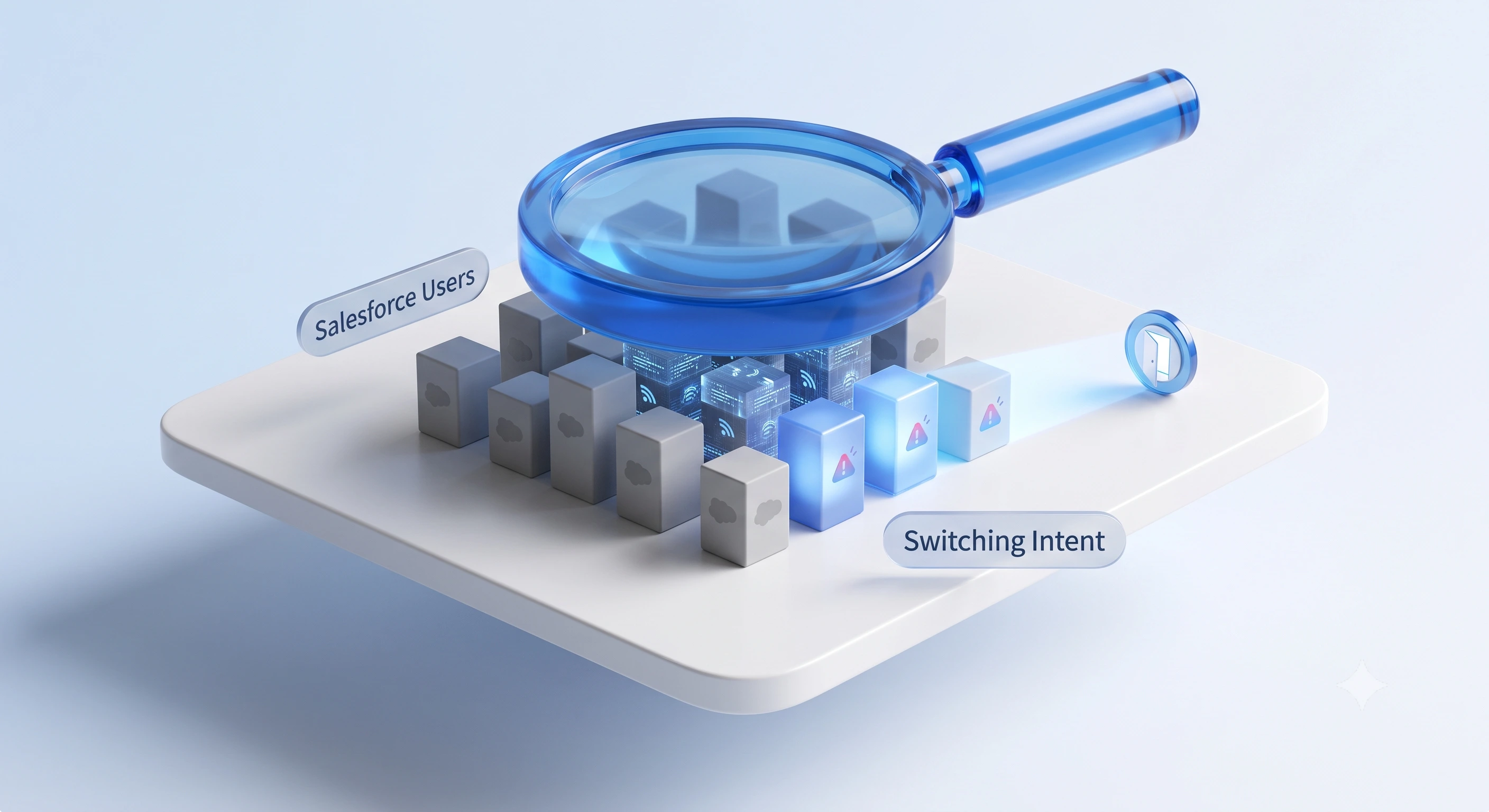
Imagine selling a CRM that competes directly with Salesforce. Your biggest opportunity isn't businesses without a CRM; it's organisations already using Salesforce that may be evaluating alternatives.
The challenge is separating satisfied Salesforce customers from those showing signs of a potential switch. A generic list of companies using Salesforce doesn't provide that context. Salesforce reports more than 150,000 customers worldwide, creating a large prospect pool. But simply knowing about companies using Salesforce doesn't tell you who fits your ICP.
That's where our customer intelligence platform adds value. We combine technographic data, buyer intent signals, and verified contact information to identify organisations that better match your targeting criteria.
How Many Companies Use Salesforce?
Before identifying companies that may switch, it's important to understand Salesforce's market presence.
Salesforce remains one of the world's leading Customer Relationship Management (CRM) platforms, serving organisations of all sizes, from startups to global enterprises.
According to Salesforce, it has over 150,000 customers globally, while independent technographic providers estimate that hundreds of thousands of businesses use at least one Salesforce product, including Sales Cloud, Service Cloud, Marketing Cloud, Experience Cloud, and Commerce Cloud.
Its popularity spans industries such as:
- Financial services
- Healthcare
- Manufacturing
- Retail
- Technology
- Telecommunications
- Education
- Professional services
This widespread adoption means the opportunity isn't finding businesses that use Salesforce; it's identifying those with the strongest likelihood of evaluating a different CRM.
What Companies Use Salesforce?
If you've searched for companies using Salesforce CRM or any of its products, you'll find organisations of every size using the platform.
Some well-known examples include:
| Industry | Examples of Companies Using Salesforce |
|---|---|
| Technology | IBM, Spotify |
| Financial Services | American Express |
| Retail | Adidas |
| Manufacturing | Toyota |
| Telecommunications | T-Mobile |
| Healthcare | Various healthcare providers and life sciences organisations |
These examples demonstrate Salesforce's broad market adoption. However, enterprise organisations often customise their CRM extensively, meaning their business needs and future technology strategies can evolve.
Why Some Companies Evaluate Salesforce Alternatives
It's important to recognise that businesses don't necessarily switch because Salesforce is ineffective. In many cases, organisations simply outgrow their existing implementation or their business priorities change.
Several factors commonly trigger CRM evaluations.
Rising Licensing Costs
As organisations expand, licensing costs often increase with additional users, products, and cloud services.
Businesses seeking to optimise operational expenses may review competing CRM platforms offering simpler pricing models or features better aligned with their current requirements.
Complex Customisation
Many enterprise Salesforce deployments evolve over several years. Custom workflows, integrations, and automation rules provide flexibility but may also increase administrative complexity.
Some organisations eventually look for solutions requiring less maintenance while improving user experience.
Low User Adoption
A CRM only delivers value when employees actually use it. If sales representatives avoid updating records or customer data becomes inconsistent, businesses may begin evaluating platforms with simpler interfaces and improved usability.
Business Transformation
Major organisational changes frequently trigger CRM reviews. Examples include:
- Mergers and acquisitions
- International expansion
- Digital transformation initiatives
- New product launches
- Cloud migration projects
During these transitions, leadership teams often reassess their technology stack to ensure systems continue supporting long-term business objectives.
Ways to Find Companies Using Salesforce Alternatives
Simply knowing a company uses Salesforce isn't enough. The real opportunity lies in identifying businesses showing signs that they may be evaluating alternatives.
Monitor Technographic Changes
One of the most effective ways to identify potential opportunities is by monitoring changes in a company's technology stack. When businesses replace ERP systems, marketing automation platforms, customer support software, or cloud infrastructure, they often review connected applications, including CRM platforms.
Technographic data and intent signals help sales teams identify these technology shifts early, allowing them to engage prospects during active transformation projects.
Look for Leadership Changes
New executives often introduce new technology strategies. Appointments such as:
- Chief Revenue Officer (CRO)
- Chief Information Officer (CIO)
- Chief Technology Officer (CTO)
- VP of Sales
can signal upcoming reviews of existing systems. A new leadership team may evaluate CRM performance, vendor relationships, and operational efficiency before making strategic technology decisions.
Track Funding and Business Expansion
Companies that receive significant investment frequently scale their operations rapidly. Funding rounds, acquisitions, international expansion, and rapid hiring often require businesses to reassess whether their CRM continues supporting future growth.
Monitoring these business events helps identify organisations more likely to explore alternative solutions.
Analyse Hiring Trends
Recruitment activity provides valuable buying signals. Companies hiring for roles such as:
- Salesforce Administrator
- CRM Manager
- Revenue Operations Manager
- Sales Operations Analyst
may be expanding their CRM capabilities.
However, organisations recruiting migration specialists, integration consultants, or broader RevOps professionals may also be preparing for larger technology changes.
Identify CRM Renewal Opportunities
CRM purchasing decisions rarely happen overnight. Many organisations evaluate competing solutions several months before contract renewals.
Understanding procurement cycles and budgeting periods enables sales teams to begin conversations before renewal decisions are finalised, significantly improving competitive positioning.
Key Signals a Salesforce Customer May Be Evaluating Alternatives
Not every company using Salesforce plans to migrate. However, certain business events and operational changes often suggest that an organisation is reviewing its technology stack.
| Buying Signal | Why It Matters |
|---|---|
| Leadership changes | New executives often reassess existing technology investments. |
| Funding or acquisitions | Growing organisations may require a CRM that better supports expansion. |
| ERP or marketing platform migration | Businesses modernising their technology stack frequently evaluate connected systems like CRM. |
| Low CRM adoption | Poor user engagement may encourage businesses to explore easier-to-use platforms. |
| Rapid hiring | Business growth often leads to new technology requirements and vendor reviews. |
| Contract renewal periods | Companies commonly compare alternative CRM solutions before renewing existing agreements. |
Looking for a combination of these signals, rather than relying on a single indicator, helps sales teams identify stronger sales opportunities.
Why Use Demand Curve Marketing for CRM Prospecting?
Finding companies that use Salesforce is relatively straightforward. The harder task is identifying which accounts have the business or technology signals that make them relevant prospects for a CRM replacement or evaluation.
Demand Curve Marketing combines technographic data, verified business contacts, buyer intent, and sales-trigger events to help revenue teams identify and prioritise accounts based on more than technology usage alone.
By replacing static prospect lists with frequently refreshed business intelligence, sales teams can improve account prioritisation, personalise outreach around relevant business events, and focus prospecting efforts on accounts that fit their target criteria.
Conclusion
Finding companies that use Salesforce is only the starting point for competitive CRM prospecting. The more valuable task is identifying accounts where technology changes, business growth, leadership transitions, hiring activity, or upcoming renewal cycles indicate that the existing CRM may be under review.
No single signal confirms that a company is ready to switch. But when technographic data is combined with business events, buyer intent, and verified contact information, sales teams can build a clearer picture of which accounts deserve attention and when to engage them.
Instead of working from a static list of Salesforce users, revenue teams can use this intelligence to prioritise accounts, tailor outreach to relevant business needs, and engage potential buyers earlier in the evaluation process.
Frequently Asked Questions
How can I find companies using Salesforce CRM?
Businesses can identify Salesforce users through technographic data providers, technology-intelligence platforms, company websites, job postings, and market research. Technographic databases are particularly useful for identifying Salesforce adoption at scale.
Is there a public list of companies using Salesforce?
There is no complete, publicly available list of Salesforce customers. Public sources may identify individual users, but comprehensive Salesforce usage data typically comes from technographic providers that track technology adoption across organisations.
Why do companies switch from Salesforce?
Companies may evaluate Salesforce alternatives because of changing business requirements, licensing costs, complex customisation, low user adoption, organisational changes, or broader technology transformation initiatives. These factors do not necessarily indicate dissatisfaction with Salesforce.
Which industries commonly use Salesforce?
Salesforce is used across industries including financial services, healthcare, technology, manufacturing, retail, telecommunications, education, professional services, and nonprofit organisations. Adoption varies by company size, business model, technology requirements, and CRM needs.
How can I identify Salesforce customers that may be evaluating alternatives?
Combine Salesforce technographic data with signals such as leadership changes, funding or acquisitions, hiring activity, technology migrations, business expansion, buyer intent, and CRM renewal cycles. Multiple signals provide stronger account-level context than technology usage alone.