




The Couchbase Ideal Customer Profile
Modern applications demand speed, scalability, and real-time performance. As businesses expand across cloud, mobile, and AI-driven environments, traditional databases often struggle to keep pace.
That's where Couchbase stands out. Built for distributed, high-performance applications, it helps organisations manage large volumes of data with low latency and high availability.
However, Couchbase isn't designed for every business. It delivers the most value to organisations operating at scale and managing complex application environments.
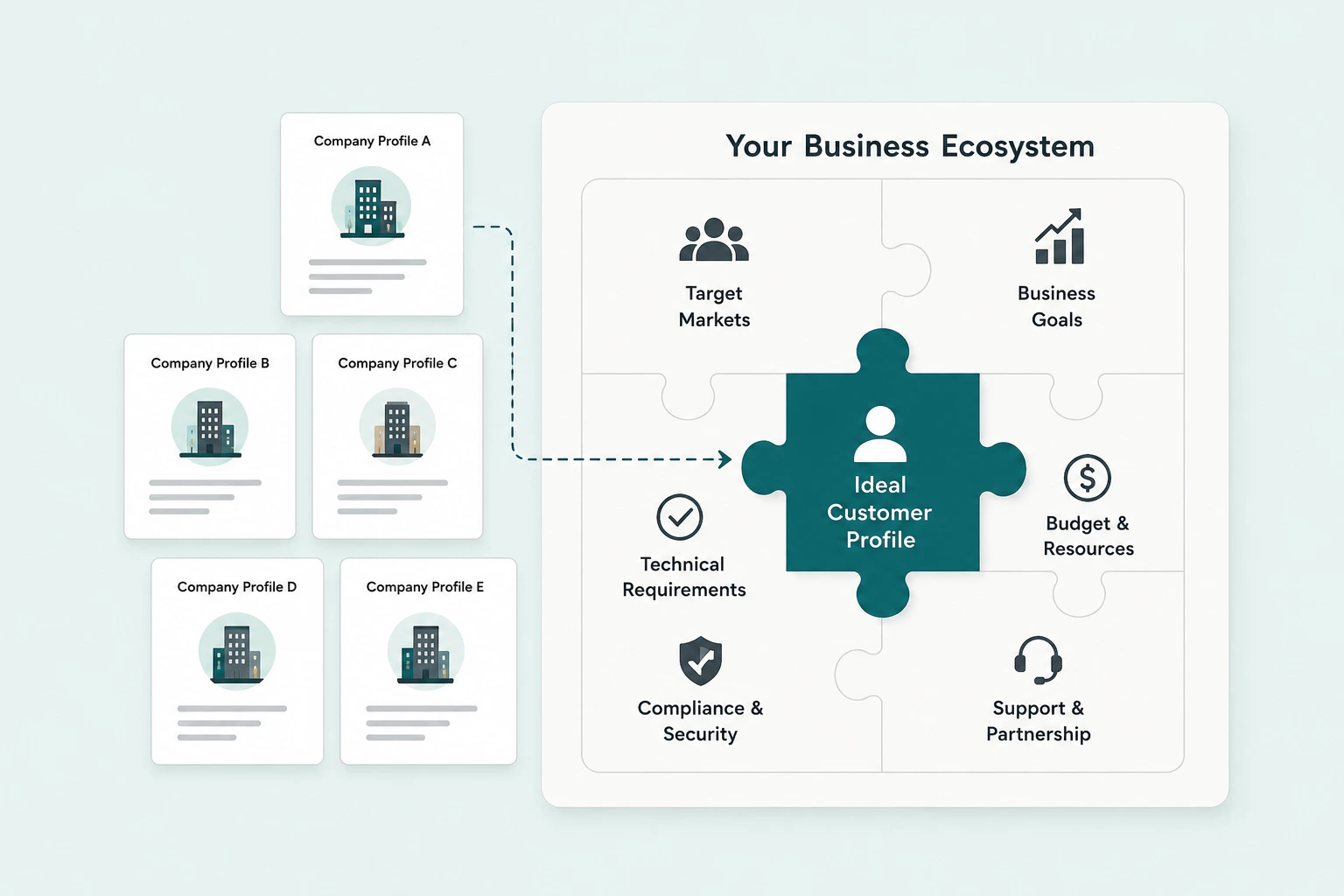
Understanding the Couchbase ideal customer profile helps GTM teams, technology vendors, and database buyers identify the organisations most likely to adopt and succeed with the platform.
This guide explores the industries, technologies, buyer personas, and buying signals that define a strong Couchbase ICP.
What Is Couchbase?
Couchbase is a distributed NoSQL database platform commonly used for high-performance applications requiring scalability, low latency, and high availability. Its enterprise and cloud offerings are widely adopted by organisations operating modern digital platforms.
Key Characteristics of Couchbase's Ideal Customer Profile
Not every organisation requires a distributed NoSQL platform. Couchbase is typically adopted by companies managing high-volume applications, complex data environments, and demanding performance requirements.
Understanding these characteristics helps GTM teams identify accounts that closely match Couchbase's ideal customer profile.
Enterprise Organisations Managing Business-Critical Applications
Couchbase is commonly adopted by mid-market and enterprise organisations operating applications where performance, availability, and scalability directly impact customer experience.
Typical characteristics include:
- 500+ employees or rapidly growing digital businesses
- Millions of customer interactions or transactions
- Multi-region application deployments
- High availability and uptime requirements
- Dedicated engineering, platform, or infrastructure teams
These organisations often view database infrastructure as a strategic investment rather than an operational necessity.
Industries Where Real-Time Performance Is Critical
Certain industries align naturally with Couchbase because they rely on low-latency applications and large-scale data processing.
| Industry | Common Use Cases |
|---|---|
| Financial Services | Real-time payments, fraud detection, and customer profiles |
| Retail & E-commerce | Product catalogues, personalisation, and inventory management |
| Travel & Hospitality | Booking platforms, loyalty programmes |
| Gaming | Player profiles, session management, real-time experiences |
| Healthcare Technology | Patient platforms, connected devices, analytics |
| Telecommunications | Subscriber management, network analytics |
These industries typically require databases capable of supporting large transaction volumes while maintaining consistent performance.
Organisations Building AI-Driven Applications
As AI adoption accelerates, many companies are modernising their data infrastructure to support intelligent applications.
Common indicators include:
- Investments in AI and machine learning initiatives
- Development of recommendation engines or personalised experiences
- Growing volumes of unstructured or semi-structured data
- Adoption of vector search and generative AI capabilities
These organisations often require flexible data models and real-time access to operational data to support AI-powered experiences.
Businesses Operating Mobile and Distributed Environments
Companies with mobile-first products or distributed operations frequently align with Couchbase's strengths.
Typical examples include:
- Field service organisations
- Logistics and transportation providers
- Retail operations with multiple locations
- Mobile application providers
- Businesses operating in low-connectivity environments
These organisations require reliable data access across devices, locations, and network conditions.
Companies Modernising Legacy Data Infrastructure
A strong adoption signal is an organisation actively modernising its technology stack.
Common triggers include:
- Migrating from legacy relational databases
- Moving toward microservices architectures
- Expanding cloud-native infrastructure
- Consolidating multiple databases and data platforms
- Addressing application performance or scalability challenges
For GTM teams, these initiatives often indicate accounts that are actively evaluating modern database platforms and are more likely to fit Couchbase's ideal customer profile.
Technographic Characteristics of a Couchbase ICP
Firmographic data shows what a company looks like. Technographic data reveals how it operates. For many GTM teams, technology adoption patterns provide some of the strongest indicators of whether an organisation is likely to evaluate Couchbase.
Companies running cloud-native applications, distributed architectures, and real-time data environments often face the scalability and performance challenges that modern NoSQL platforms are designed to address.
Technologies Commonly Found in Couchbase Accounts
| Technology Signals | Why It Matters |
|---|---|
| AWS, Azure, GCP | Indicates cloud-native infrastructure adoption |
| Kubernetes | Supports distributed application environments |
| Docker | Reflects modern application deployment practices |
| Apache Kafka | Signals real-time data processing requirements |
| Microservices Architecture | Often requires flexible and scalable data platforms |
| Event-Driven Systems | Creates demand for low-latency data access |
These technologies don't guarantee Couchbase adoption, but they frequently appear in environments where organisations begin evaluating modern distributed databases.
Key Buyer Personas Involved in Couchbase Adoption
Database purchasing decisions rarely involve a single stakeholder. Understanding who influences evaluation and procurement helps GTM teams engage the right people during the buying process.
CTOs and Engineering Leaders
Chief Technology Officers, VP Engineering leaders, and Heads of Engineering typically evaluate:
- Long-term scalability
- Platform reliability
- Infrastructure modernisation
- Future technology strategy
They focus on whether a database platform can support business growth and evolving application requirements.
Platform and Infrastructure Teams
These teams assess operational considerations such as:
- Deployment flexibility
- High availability
- Cloud compatibility
- Infrastructure efficiency
Their role is often critical during technical evaluations and proof-of-concept stages.
Database Architects and Technical Leaders
Database architects focus on:
- Performance requirements
- Data modelling flexibility
- Replication and availability
- Integration with existing systems
They help determine whether Couchbase aligns with current and future application needs.
Product and Digital Transformation Leaders
In organisations investing in digital innovation, product and transformation teams may also influence adoption decisions.
Their priorities often include:
- Faster application development
- Improved customer experiences
- AI and personalisation initiatives
- Mobile and omnichannel capabilities
What Signals Indicate a Company May Be Evaluating Couchbase?
Beyond firmographic and technographic characteristics, certain business and technology events often indicate that an organisation is actively evaluating modern database platforms.
Infrastructure Modernisation Initiatives
Companies replacing legacy systems frequently reassess their database strategy.
Common indicators include:
- Legacy database migration projects
- Cloud transformation programmes
- Application modernisation initiatives
- Platform consolidation efforts
Expansion of Cloud-Native Environments
As organisations adopt Kubernetes, microservices, and distributed architectures, database requirements become more complex.
This often creates demand for platforms capable of supporting modern application environments at scale.
AI and Personalisation Investments
Businesses developing AI-powered applications, recommendation engines, or intelligent customer experiences often require flexible and scalable data infrastructure.
Hiring AI engineers, launching GenAI projects, or investing in data platforms can indicate growing database requirements.
Mobile and Distributed Application Growth
The launch of mobile-first applications, field service platforms, and geographically distributed systems often creates new demands around data availability and synchronisation.
Performance and Scalability Challenges
Many organisations begin evaluating Couchbase when existing systems struggle to support growth.
Common pain points include:
- Increasing application latency
- Growing transaction volumes
- Scalability limitations
- Operational complexity across multiple environments
For GTM teams, these signals often indicate accounts that are moving from awareness to active evaluation.
Which Organisations May Not Be a Strong Fit?
While Couchbase serves many large-scale application environments, not every organisation requires a distributed NoSQL platform.
Companies with simple relational workloads, limited application complexity, small engineering teams, or low transaction volumes may find that alternative database solutions adequately meet their requirements.
The strongest Couchbase candidates are typically organisations managing high-performance applications, distributed systems, and rapidly evolving data environments.
Couchbase ICP Snapshot
For GTM teams, the following characteristics typically indicate a strong Couchbase prospect.
| Category | Ideal Characteristics |
|---|---|
| Company Size | Mid-market and enterprise organisations |
| Infrastructure | Cloud-native, hybrid-cloud, or distributed environments |
| Key Technologies | Kubernetes, Docker, Kafka, cloud platforms |
| Industries | Financial Services, Retail, Travel, Gaming, Telecom, Healthcare Technology |
| Buyer Personas | CTOs, Engineering Leaders, Infrastructure Teams, Database Architects |
| Adoption Triggers | Database modernisation, cloud migration, AI initiatives, scalability challenges |
While no single attribute guarantees adoption, organisations matching multiple criteria are often the strongest candidates for Couchbase evaluation.
Conclusion
The strongest Couchbase prospects are rarely identified by industry alone. They are typically defined by infrastructure complexity, modern technology adoption, and ongoing digital transformation initiatives.
For GTM teams, combining firmographic, technographic, and buying-signal data creates a clearer picture of which organisations are most likely to evaluate Couchbase. For technology buyers, these same characteristics can help determine whether Couchbase aligns with current performance, scalability, and application requirements.
The goal isn't simply to identify organisations that could use Couchbase. It's to identify those most likely to benefit from it and invest in it successfully.
Frequently Asked Questions
1. What is Couchbase's ideal customer profile?
Mid-market and enterprise organisations requiring real-time performance, scalability, cloud-native infrastructure, and support for modern applications across web, mobile, and AI environments.
2. Which companies are most likely to switch to Couchbase?
Companies facing database scalability issues, rising infrastructure costs, performance bottlenecks, or limitations with legacy relational and NoSQL database platforms.
3. What signals indicate a company may be evaluating Couchbase?
Cloud migration projects, microservices adoption, Kubernetes deployment, database modernisation initiatives, AI investments, and growing application performance requirements.
4. How can GTM teams identify high-fit Couchbase prospects?
By combining firmographic, technographic, and intent data to find organisations whose infrastructure, technology stack, and growth initiatives align with Couchbase adoption.
5. How does DemandCurveMarketing help identify Couchbase prospects?
DemandCurveMarketing helps GTM teams uncover high-intent Couchbase accounts using accurate technographic intelligence, buyer signals, and targeted account identification strategies.